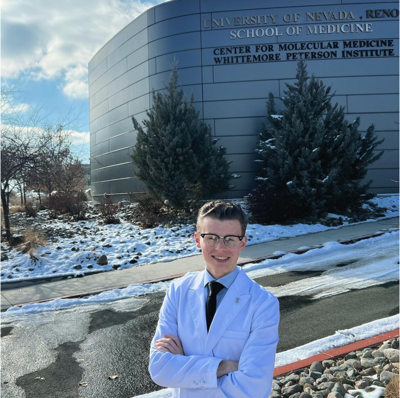
Riley Gillis, a Hug High School graduate and University of Nevada, Reno Honors Student, was recently selected for a National Institutes of Health (NIH) Maximizing Access to Research Careers (MARC) award after two of his manuscripts were accepted for publication through research journals at the University of Nevada, Reno and Columbia University in New York.
The NIH MARC fellowship provides a very select few undergraduates across the country with partial or full tuition, $15,000/year stipend, and complete coverage of travel and research expenses to conduct research around the globe with the goal of developing the next generation of biomedical researchers.
In exchange, students commit to earning a graduate-level biomedical degree,
in Gillis’s case, an MD-PhD. Gillis, a Reno native, published his first peer-reviewed research paper studying trends of obesity comorbidities through the Nevada State Undergraduate Research Journal (NSURJ) shortly after graduating from Hug High School in 2022.
An extraordinary feat as most scientists aren’t able to publish as a first author until at least the final year of graduate school, much less, their first year at undergrad.
His second manuscript, providing recommendations for prevention of Ebola in sub-Saharan Africa, is being released later this month through the Columbia Scientist (CUSJ) at Columbia University
“As a chronically ill child with limited access to health insurance after my parents lost their jobs and our house in bankruptcy during the recession, I understand the pressing need for equitable, upstream methods for prevention of disease in this country,” said Gillis when asked about his background.
“The COVID-19 pandemic has only exacerbated the already calamitous issue of unhealthy base populations in even a country as privileged as America. We as scientists need to continue to work towards smart, public-health-oriented solutions to control global disease so that we won’t be so caught off guard in the next pandemic.”
Gillis is currently a researcher at the Center for Molecular Medicine and works to develop and purify monoclonal antibodies for the production of rapid diagnostic tests under the direct mentorship of UNR Med, Microbiology & Immunology Department Chair, Dr. David AuCoin.
The AuCoin Laboratory focuses efforts on biodefense and some of the most dangerous pathogens/diseases known to man including plague (The Black Death), Ebola, Anthrax, Ricin, and COVID-19.
Gillis has senior-standing at the University, but he plans to stay until his 3rd or 4th year before matriculating into a PhD or physician-scientist (MD-PhD) training program.
“It’s a long and difficult road ahead… I still need to discover a lot about myself before making decisions on what’s next but I am incredibly grateful for the opportunities and generous support of my mentors, UNR, the NIH, and my amazing parents and brothers.”
(Riley Gillis assisted with this report.)