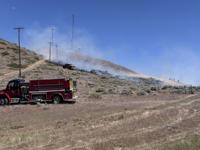
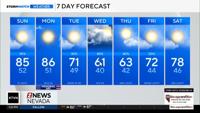
While the April fire outlook is forecasting near average fire potential, the May outlook is trending above average for parts of Northern California. Our soil moisture could be better, but it’s worse in some spots than others.
Thanks to a dry 2026, as well as record-breaking warmth, our fuels in western Nevada are much drier than normal. Fuels are as dry now as they usually are in early June. With that being said, according to the Great Basin Coordination Center, the Truckee Meadows is still in the green-up phase, and our upcoming rain chances will help our cause. Fire season is technically year-round in Northern Nevada, but it reaches its peak during the summer and fall as temperatures warm and fuels dry out.

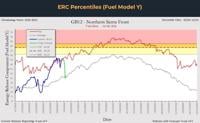
This chart shows how dry our fuels are, with similar conditions to early June opposed to April. Thankfully, some much needed rain will lower energy release values back to normal by the end of the week.
Soil moisture can be hard to classify, and it is difficult to get a general idea by looking at one product. The soil moisture product on NRCS’s page shows our basins with soil moisture values slightly above 100%, with a small amount below that. However, other products, like those from the Climate Prediction Center, show soil moisture readings below average. According to the CPC, there is a deficit for April 6, but if you look at the month of March, soil moisture values are near average for the Tahoe Basin and far western Sierra Front.

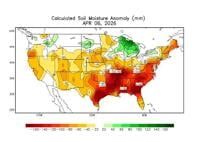
The Crop-CASMA product from NASA shows more of a deficit for the Truckee Meadows, as opposed to a neutral level that is close to average. This product is also for the top 1 meter, whereas the NRCS product is for 8 inches.

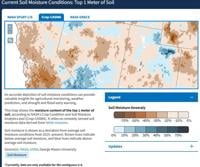
Another product from NASA shows the percentage of available soil moisture, leaving the Sierra with some water, but hardly anything east of the mountains.

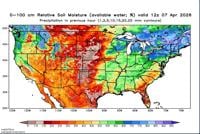
According to the American Meteorological Society, soil moisture can be calculated in a variety of different ways, and the type of soil and its surrounding vegetation matter. Soil moisture measures the amount of water as well as water vapor within the soil when it is not saturated. Surface-level soil moisture is taken within the first 10 cm, while root soil is measured within 200 cm of the surface. The water is collected within the pores of the soil. What is normal soil moisture for Nevada might be much different for areas like Florida, where they typically get more rain.
According to drought.gov, more research is being done to study soil moisture, and more products like satellites are being invented to measure it.