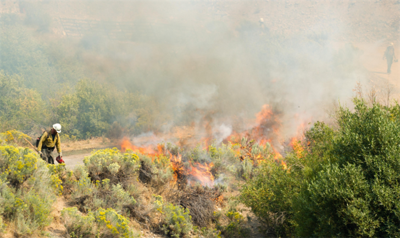
The Humboldt-Toiyabe National Forest and Nevada Department of Wildlife plan to begin aerial fire rehabilitation treatments in the Mountain City Ranger District during the last week of August, targeting 11,000 acres in the South Sugarloaf Fire burn scar.
The work will take place in the Bull Run and Independence Mountains near Maggie Summit Road, Trail Creek Road and the Cobb Creek area.
The treatments are intended to reduce cheatgrass, an invasive, non-native weed, and give native plant communities an opportunity to recover. “The Forest Service, in partnership with the Nevada Department of Wildlife, is taking proactive steps to restore the South Sugarloaf burn scars on the Mountain City Ranger District,” said Wendy Markham, deputy district ranger for the Mountain City-Ruby Mountains-Jarbidge Ranger District. “By applying targeted treatments to reduce cheatgrass, a highly invasive, non-native weed, we’re giving native plant communities the opportunity to recover and thrive. Healthy native vegetation is essential for building resilient landscapes and supporting the rich wildlife habitat that Nevadans value.”
The Mountain City work follows the completion of operations covering about 13,000 acres in the South Rubies.
Aerial treatment is the first phase of a broader restoration effort. After herbicide is applied, the Forest Service and NDOW plan to reseed priority areas with native seed mixes to support the long-term recovery of sagebrush and other key plant communities.
The agencies also plan to protect sensitive riparian zones as part of the work, with the goal of supporting water quality, fish habitat and wildlife movement corridors.
The project is part of the Nevada Shared Stewardship Agreement, a landscape-scale partnership signed in 2019 involving the Forest Service, Bureau of Land Management, U.S. Fish and Wildlife Service, Nevada Department of Conservation and Natural Resources, Nevada Department of Agriculture and Nevada Department of Wildlife.
The agreement calls for agencies to work across federal, state, tribal and private lands to manage wildfire risk, restore fire-adapted ecosystems and improve landscape resilience.
Hunters and recreationists should be prepared for ongoing operations in the area. Temporary closures or flight activity may occur, and visitors are encouraged to watch for posted notices or contact the local ranger district for current information.