

NEW YORK (AP) — Catapulted by the market debut of his rocket company SpaceX, Elon Musk is now the world's first trillionaire.

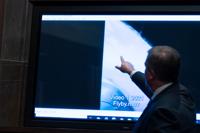
Steven Spielberg's new film “Disclosure Day” explores extraterrestrial life and its impact on religion. UFOs, now also called UAPs, are gaining mainstream attention. The Pentagon released UFO files in May, sparking public curiosity. Former President Barack Obama set off a media frenzy by suggesting aliens exist in an interview. Some believe extraterrestrial life could challenge religious beliefs, while others see it as beneficial. Some Catholic figures — such as Vice President JD Vance and Monsignor Stephen Rossetti — view UFOs as demonic, though the Catholic Church remains open to the idea of alien life. Theologians and historians note that interest in otherworldly beings dates back centuries.


Extreme floods that once swamped coastal communities only rarely are becoming far more common as climate change caused by humans pushes sea le…


NASA has revealed the crew for its Artemis III mission, the next step in eventually landing astronauts on the moon. NASA’s Randy Bresnik, Frank Rubio, Andre Douglas and the European Space Agency’s Luca Parmitano won’t fly to the moon or land on the surface. Instead, they’ll orbit Earth while practicing docking their Orion capsule with lunar landers. The demo is targeted for 2027. NASA’s Artemis program aims to land astronauts on the moon for the first time since the 1970s.


NASA's Maven spacecraft around Mars has been declared dead after six months of radio silence. Maven was launched in 2013 to study the red planet's atmosphere. It fell silent in December after passing behind Mars. NASA confirmed Wednesday that the mission is over. Data indicated that the spacecraft went into a fast spin, which disrupted its orbit and drained the onboard batteries. A review board convened by NASA earlier this year concluded that the spacecraft is useless and unable to be recovered. Besides studying Martian weather, Maven helped relay information from NASA's Curiosity and Perseverance rovers on the surface.


The group leading the charge in the search for extraterrestrial life has given the all clear. The SETI Institute said Wednesday that extensive radio scans by its telescope in Northern California have found no signs of alien tech from our solar system's latest interstellar visitor. The object labeled 3I/Atlas was discovered last summer sweeping through our neck of the cosmic woods. Scientists identified it as a comet that migrated from another star. SETI says it conducted more than seven hours of observations, searching through a wide range of radio signals. But no evidence of extraterrestrial technology was found.
This image provided by NASA shows four-in-one photos of Mars taken by NASA's Maven spacecraft that's been orbiting the red planet since 2014? Maven is no more, NASA just declared it dead. (NASA via AP)


When the double boom rang out in New England over the weekend, shaking homes and sending pets fleeing, questions started flooding social media.


A new report from the United Nations weather agency gives a three-out-of-four chance that the next five years will average more than 1.5 degrees Celsius above pre-industrial temperatures. That's the international safety limit set in 2015. There’s an even higher chance — 86% — that one of the next five years will smash the global heat record set in 2024 and next year looks like a leading contender. So expect more extreme weather. The next five winters in the Arctic are predicted to be nearly 3 degrees Fahrenheit warmer than the last five years. Meteorologists also forecast an Amazon drought that may spark wildfires.


CAPE CANAVERAL, Fla. (AP) — SpaceX Starship launches are on hold pending an investigation into last week’s test flight.