CAPE CANAVERAL, Fla. (AP) — SpaceX Starship launches are on hold pending an investigation into last week’s test flight.
From
To


NASA is already ordering landers, rovers and drones for a sprawling moon base, less than two months after the Artemis II mission. The space agency outlined the first phase of its moon base plans on Tuesday, awarding hundreds of millions of dollars in contracts to U.S. companies. Jeff Bezos' Blue Origin will provide the landers that will deliver a pair of moon buggies to the lunar surface at a spot near the moon's south pole. Those will be built by Astrolab and Lunar Outpost. Firefly Aerospace will get drones to the moon. All this hardware should arrive ahead of the first Artemis astronauts' landing, which is planned for as early as 2028.
FILE - In this photo provided by NASA and captured by the Artemis II crew from lunar orbit, the moon eclipses the sun on April 6, 2026. (NASA via AP, File)

JIUQUAN, China (AP) — China launched the Shenzhou 23 spacecraft Sunday night with three astronauts heading to its space station, including one…
SpaceX has launched its biggest, most powerful Starship yet. The rocket blasted off from the southern tip of Texas on Friday, carrying 20 mock Starlink satellites on a test flight extending halfway around the world. Nothing was recovered as planned. It’s the 12th test flight of the rocket that Elon Musk is building to get people to Mars one day. But first comes the moon and NASA’s Artemis astronaut program. SpaceX’s newest Starship model made its debut two days after Musk announced he’s taking his company public.

SpaceX's Starship rocket lifts off during a test flight from Starbase, Texas, Friday, May 22, 2026. (AP Photo/Eric Gay)

SpaceX's Starship rocket lifts off during a test flight from Starbase, Texas, Friday, May 22, 2026. (AP Photo/Eric Gay)

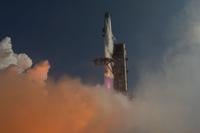
SpaceX's mega rocket Starship makes a test flight from Starbase, Texas, Friday, May 22, 2026. (AP Photo/Eric Gay)


SpaceX's mega rocket Starship makes a test flight from Starbase, Texas, Friday, May 22, 2026. (AP Photo/Eric Gay)

SpaceX's mega rocket Starship makes a test flight from Starbase, Texas, Friday, May 22, 2026. (AP Photo/Eric Gay)