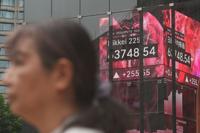
Global shares are mixed in cautious trading as investors watch for next steps in the U.S.-Iran conflict. Shares fell in France and were little changed in Germany and Britain. U.S. futures rose. In Asia, benchmarks finished higher in Japan and South Korea, while declining in Australia. In China, shares fell in Hong Kong but rose in Shanghai. U.S. futures were higher. Tokyo reported that it logged a trade deficit in the last fiscal year, the fifth straight year of deficits. Oil prices have edged higher. Markets are focused on what will happen to the Strait of Hormuz, a narrow waterway that vital route for oil shipping.
Shares are mixed in Asia, echoing a rally on Wall Street driven by hopes United States and Iran may resume talks to end their war. The price of Brent crude edged 0.2% lower but was still above $98 a barrel. On Tuesday, U.S. stocks advanced to near their all-time high, with the S&P 500 rising 1.2%. The Dow industrials gained 0.7%, and the Nasdaq composite climbed 2%. Lower oil prices help bring down costs for all kinds of businesses. President Donald Trump said he was extending the ceasefire with Iran at Pakistan’s request while awaiting a “unified proposal” from Tehran. The U.S. military was keeping its blockade of Iranian ports
U.S. stocks and oil prices flip-flopped as uncertainty rose about what will happen following a two-week ceasefire in the war with Iran, which had been set to expire Wednesday. The S&P 500 erased an early rise and fell 0.6% Tuesday after Vice President JD Vance called off a trip to Pakistan, where he was expected to lead U.S. negotiators in talks with Iran to extend the ceasefire. The Dow Jones Industrial Average fell 293 points after erasing an earlier rise of 400 points, and the Nasdaq composite lost 0.6%. The moves were more modest than the swings that rocked Wall Street earlier in the war.
For investors hurtling toward retirement, sitting tight with stocks has been the path of least resistance in recent years. Stocks, especially …
Oil prices climbed following the latest rise of U.S.-Iran tensions, but the moves were more modest than they were earlier in the war. U.S. stocks meanwhile gave back a bit of their record-breaking rally Monday. The S&P 500 slipped 0.2% from its all-time high. The Dow Jones Industrial Average edged down by less than 0.1%, and the Nasdaq composite fell 0.3%. The price for a barrel of Brent crude oil topped $95 again. The relatively muted moves suggest investors still see a possibility of a U.S.-Iranian agreement that could get oil flowing again from the Middle East to customers worldwide.
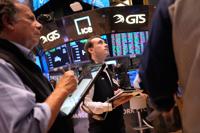
Trader Terrance McCauley, left, and specialist Anthony Matesic confer on the floor of the New York Stock Exchange, Monday, April 20, 2026. (AP Photo/Richard Drew)
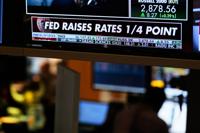
Trader Michael Milano, left, works on the floor of the New York Stock Exchange, Monday, April 20, 2026. (AP Photo/Richard Drew)
Specialist Michael Pistillo works at his post on the floor of the New York Stock Exchange, Monday, April 20, 2026. (AP Photo/Richard Drew)
Specialist James Denaro works at his post on the floor of the New York Stock Exchange, Monday, April 20, 2026. (AP Photo/Richard Drew)
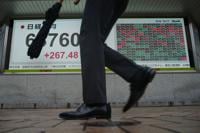
People walk in front of an electronic stock board showing Japan's Nikkei index at a securities firm Monday, April 20, 2026, in Tokyo. (AP Photo/Eugene Hoshiko)