
Tuesday officially marks five weeks until Election Day.
The Reno Mayoral race is set between former Nevada State Treasurer and Lieutenant Governor Kate Marshall and Reno City Councilmember Kathleen Taylor.
Last week, we did a Reality Check on “Kate Marshall Gambles”.
It was an attack ad from Kathleen Taylor’s campaign.
Now, we’ll look at a new ad, “Shortfall,” where Marshall is returning shots at the councilmember.
Claim one: Lying
“Why is Kathleen Taylor lying about Kate Marshall,” the narrator initially asks.
Verdict: Mostly true
Recently, as we mentioned previously, we fact-checked an ad from Taylor’s campaign.
In our findings on the five claims made in the ad, only one was true. One was false, and the others were misleading.
Claim two: Data center approvals
“Taylor voted to allow multiple data centers in Reno,” the narrator claims.
Verdict: True
Taylor voted to deny an appeal of an approval of the Webb Data Center by the Reno Planning Commission.
She also voted to reverse the Planning Commission’s denial of the Oppidan data center project and approve it.
Claim three: Data center regulations
“And even voted against regulating them,” the narrator continues.
Verdict: Misleading
This claim dates back to a February 2025 Reno City Council Meeting..
Council was discussing initiating a text amendment to put further restrictions on data centers.
The city already had some regulations, such as a conditional use permit process and requiring data center companies to go before the Reno Planning Commission.
The council can appeal a decision made by the commission.
The permit allows the commission and council to set forth regulations on data centers, on a case-by-case basis for land use issues such as parking, noise, and lighting.
It does not regulate water and power.
“Water and electrical service are outside the City’s regulatory authority and are not regulated through the conditional use permit process,” said Angela Fuss, Assistant Director of Development Services, City of Reno. “The City does not regulate, restrict, or establish limits on the amount of water or electrical power a project may use.”


During the presentation, for the three data centers at the time, it showed energy and water use, comparing the data centers to other infrastructure in the city.

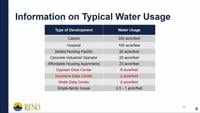


The text amendment vote ended in a tie, 3-3, so it did not pass.
One of those three who voted ‘nay’ was Taylor.
“I’m not sure I would want to make these text amendments or regulations and then also have the CUP process on top of that," Taylor said during the meeting.
Not passing the text amendment meant no further regulations.
Then in April of this year, the council changed its mind and voted to initiate a text amendment.
Taylor was the only ‘no’ the two times the council voted for a data center moratorium.
"I voted for more regulations and against a moratorium; those things aren't the same," she said.
Claim four: Budget shortfall
"And Taylor's reckless spending pushed Reno in a $24 million shortfall,” the narrator says.
Verdict: False
Taylor has one vote out of seven on the Reno City Council. One councilmember does not have the power to spend recklessly. It would reflect on the council as a whole.
In regard to the budget shortfall, Reno City Manager Jackie Bryant says it was caused largely by decreased revenues and increased costs to provide city services.
“We have, all of the local governments in Nevada have a revenue challenge because of the way property tax and C-Tax work," Taylor said.
Claim five: More money in the state’s pocket
"But as State Treasurer, Kate Marshall saved Nevada millions by rooting out waste," the narrator says.
Verdict: True
When Marshall first started in the State Treasurer’s Office, she noticed that some money had been deposited into the state treasury.
She told the Nevada Legislature, and then a legislative auditor found that more than $6 million had not been going to the state.
Claim six: $50 million recouped
"And she took on Wall Street banks to save us more," the narrator says.
Verdict: True


As we reported in our Reality Check on Taylor’s ad attacking Marshall, the former State Treasurer sued Lehman Brothers after a lending agent contracted with the state invested $50 million in them before they went bankrupt.
It took Marshall seven years, but she recouped 99.6 percent of the investment.
