
If you’ve ever gone to the beach, you may have noticed that it tends to feel a bit cooler than if you were further inland. That isn’t always the case, with heat warnings and advisories in place along parts of the coast in the southeast as of writing on Wednesday, but in general you can count on coastal areas being a few degrees cooler than landlocked regions.
The temperature drop exists on the coast because of the effect much cooler water has on the surrounding air. Water, unlike land has a higher specific heat capacity, meaning it takes more energy to warm up. Land, conversely, has a much lower specific heat and takes much less energy to warm up. As a result, the ocean temperature takes quite a while to warm, which contributes to the peak of hurricane season being in August and September, when sea water temperatures are at their warmest.
On a day to day basis, the water temperature tends to be much cooler than the land even on the hottest of days. Cooler water will cool the surrounding air, which will then result in cooler temperatures along the coast. The differential can sometimes even be great enough that you’ll see something called a sea or lake breeze develop, where colder, denser air over water rushes inland to replace rising less dense hot air.
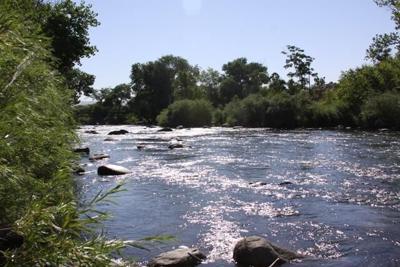
These processes are most easily seen for large-scale features such as big lakes and oceans. For a process as relatively simple as we are discussing, it’s worth considering whether we can scale it down to the size of a river. If it’s a hot day and you decide to picnic near a river will you feel cooler? It’s a complex question but the short answer is no. The reason why the answer is no is that rivers are too small-scale of a feature for the most part, and so the cooling effect of the air above the water on the surrounding air is negligible. That’s not to say that the weather directly above the river cannot be impacted. For example, the higher moisture content in the air above a river as opposed to surrounding land can result in localized fog over a river on cold mornings as the air cools enough for water vapor to condense into cloud droplets. Additionally, on some larger rivers, a strong enough temperature gradient can be built up between the cooler river air and warm land to induce river breezes, which have been seen in locations such as the Amazon. For a river such as the Truckee however, these effects are not really observable due to the smaller nature of the river.