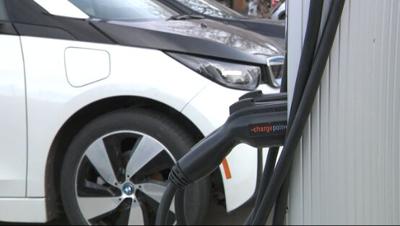
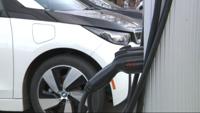


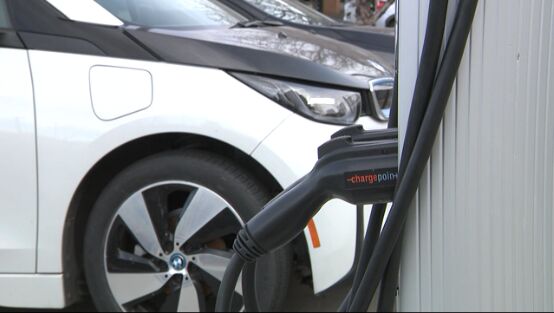
President Joe Biden has signed the $1.2 trillion Infrastructure Investment and Jobs Act into Law. Nevada will get $4.038 billion for a wide range of infrastructure projects. One of those will be the establishment of electric vehicle charging stations.
"What we want to see is a penetration of electric vehicle charging stations all across the country to take down any question about people who want to purchase electric vehicles the ability to charge, to get the fuel that's necessary," Jennifer Granholm, Secretary of the U.S. Department of Energy said.
Nevada will receive $38 million for its EV charging stations. They are expected to be built in areas that the private sector has not installed them.
"Places, for example, that are rural or in poorer communities, in a lot of urban places where the private sector has decided not to go," Granholm said.
Granholm says one of the reasons the private sector has not put charging units in those areas is because most people who own EVs have high incomes. The secretary says charging stations are essential for the country to transition away from gas-powered vehicles.
"The great thing is the battery technology for the electric vehicles is really improving, significantly, and the price is coming down and some, depending on the model can go over 300 miles on a single charge," Granholm said.
Unfortunately, 300 miles per charge is not enough for people who want to take long road trips until the infrastructure is available.
"Highways have to have charging stations, quick-charging, that people can stop like at a rest stop and plug in, charge their vehicle and keep going," Granholm said.
Congress is negotiating the Build Back Better Act. One of the provisions in that bill aims to make EVs more affordable.
"Make them on par with a gas-powered engine, so when somebody goes to a dealer, there will be a tax credit that they get right off the top to bring down the price at the time of purchase," Granholm said.
The new law also contains $65 billion to upgrade transmission lines across the United States, research for electricity distribution technologies, the promotion of smart grid technologies and research for next generation technologies like nuclear reactors, carbon capture and clean hydrogen. In Nevada, the funding could help make the grid withstand weather events, wildfires and other natural disasters.
"It's going to help us both make sure that grids are resilient from these extreme weather events and that, right now, of course they're built on poles from the 1950s with wires hanging across," Granholm said. "That's not the most resilient kind of thing or they were built to last 50 years and it's gone well beyond that."
Nevada has lithium and boron mining. Funding could help create a way to process the minerals domestically, rather than shipping it to Asia for processing. That could help with the processing of batteries, as well as the recycling and development of them.