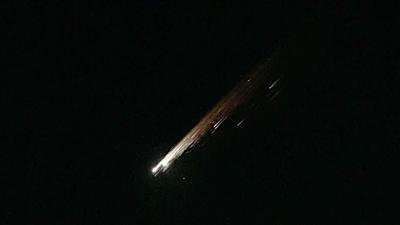
People in the Reno area got quite a show, Wednesday, when a fireball streaked across the night sky around 9:45. Many initially thought it was a comet or meteor. Experts say it was actually debris from a Chinese rocket. Dan Ruby is the Director of the Fleischmann Planetarium & Science Center at the University of Nevada. He says there are distinct differences between space junk and meteors.
"Both things are things from space that are burning up really spectacularly when they hit the thick, protective air around earth, but space rocks are going relatively a lot faster than orbiting man-made things," Ruby said.
Ruby says last night's fireball was probably traveling at about 20,000 miles per hour, while meteors can travel tens of thousands, or even 100,000 miles per hour.
"If something streaks across the sky in a few seconds, it's probably a meteor," Ruby said. "Something takes a few minutes to go across the sky and burns up spectacularly, it's probably a man-made, either piece of space junk or stage of a rocket."
Not only was Wednesday night's debris visible for a couple of minutes, it also looked much closer than it actually was. Ruby says rocket debris enters the earth's atmosphere and usually burns up, 5-10 miles above the earth.
"That's still pretty high up and you can see that for hundreds and hundreds of miles," Ruby said. "So everybody swears they saw it land just over the next mountain range, and it didn't. It was visible for many, many, many miles."
The fireball was reported throughout the western U.S., Ruby says it is highly unlikely any of the debris reached the earth's surface before it burned up and disintegrated. It often happens when rockets are launched into space, and separate into chunks in stages.
"The first stages fall into the ocean, or in Russia's case, the middle of nowhere," Ruby said. "The upper stages make it almost to orbit. So, they can go around the earth for awhile before they kind of tumble back to earth."
Ruby says the equipment breaks into tens of thousands of pieces and heats up as it moves through the atmosphere. Much of the debris is made up of material like aluminum and titanium. Since titanium burns more slowly than other materials, he says it would be the only pieces that could even possibly make it back to earth, and that finding one would be less likely than winning the lottery.
"They disintegrate at different rates and different colors, and it looks a lot more impressive," Ruby said. "It's cool. It looks cool and it also, I guess, can be scary but it was safe and just a fantastic sight."
The Delta Aquarid meteor shower is happening, where you can see 20 meteors per hour. Ruby says the greatest meteor shower of the year will happen on August 12.
You can see other viewer pictures of the debris here.
