Fallon residents have avoided a possible disaster, now that the peak of spring run-off has passed.
The winter's record precipitation numbers forced local, state, and federal officials to start flood mitigation efforts, starting in February. Now, they are declaring victory over Mother Nature.
"We couldn't be more thrilled with how things turned out," Rusty Jardine, General Manager of the Truckee-Carson Irrigation District said. "We've managed to avoid any kind of damage to people downstream of Lahontan."
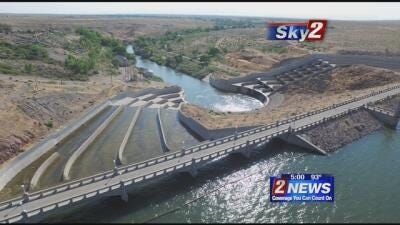
Water was being released from the Lahontan Dam at a rate of 3,000 cubic feet per second, to allow the high volume of water that was flowing into the reservoir. That is about three times more water than the Carson River can handle downstream, and Fallon would have almost certainly flooded. To alleviate those problems, crews cleaned the Carson River channel and built a spillway on the V Line Canal to send excess water into the desert. Then came the Big Dig, which is a 16-mile canal to funnel that water to the Carson Sink.
"We all came together and we provided something that I think was extraordinary," Jardine said. "I think other communities can look at us and go 'This is the way it ought to be.'"
Lake Lahontan is about as full as it can possibly be, this late in the year, holding close to 300,000 acre feet of water.
"We actually got it to the very top and now we're starting to inch down as the demand, downstream, exceeds what's coming into it," Jardine said. "It's where we want to be."
Exactly two years ago, the lake had less than 5,800 acre feet of water, so today is a stark contrast to what Fallon farmers faced, after four years of drought. This year, farmers did not have to pay for irrigation water during flood operations. What might be more important is they still have an almost-full reservoir, halfway through the irrigation season.
"We've never seen that kind of supply before," Jardine said. "We're thinking that in the year to come, we're probably going to see quite a reserve here at Lahontan, and then we'll have to see again what Mother Nature is going to do in terms of future conditions."
If next spring presents the same challenges, the infrastructure is already in place to channel the water away from Fallon. The Lahontan Dam is 102 years old. While it requires some maintenance, Jardine said it held up well. Especially, since it is designed for irrigation, not flood control.
"We pushed this dam," Jardine said. "We asked it to do something that it had never had to do before."
Fallon is full of green crops like corn and alfalfa, thanks to the abundance of water. Farmers will have more than enough water to get them through the irrigation season, which ends in November. Jardine says bout one-third of the Lake Lahontan's water will be left by then, which is still a good head-start, heading into 2018.
