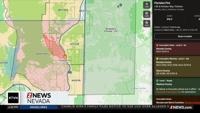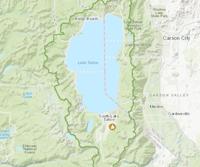

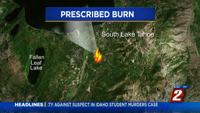


The Tahoe Fire & Fuels Team (TFFT) is scheduled to continue prescribed fire operations this week at Lake Tahoe. Conditions and weather permitting, the USDA Forest Service Lake Tahoe Basin Management Unit is planning to conduct an understory burn on 13 acres near the east side of Pioneer Trail between Jicarilla Drive and Golden Bear Trail on Wednesday, June 28.
Forest Service fire prevention staff and partners will be onsite answering questions on Wednesday from 9-4:30 p.m. on Pioneer Trail across from Jicarilla Drive.
Prescribed fire managers use different methods to remove excess vegetation and reintroduce low-intensity fire into forests including pile, broadcast, and understory burning. Pile burning involves burning slash piles that are constructed by hand or mechanical equipment. Broadcast and understory burning use low-intensity fire across the ground to remove fuels under specific environmental conditions with fire confined to a predetermined area. Prescribed fires are meant to mimic naturally occurring fire, which is an essential part of many different ecosystems, and produces fire behavior and fire characteristics required to attain resource management objectives.
The team says smoke will be present.
Smoke from prescribed fire operations is normal and may continue for several days after an ignition depending on the project size, conditions, and weather. Prescribed fire smoke is generally less intense and of much shorter duration than smoke produced by wildland fires.
Prescribed fire managers use different methods to reintroduce low intensity fire in forests including pile and understory burning. Pile burning involves burning slash piles that are constructed by hand and mechanical equipment and is intended to remove excess fuels (branches, limbs, and stumps) that can feed unwanted wildfire. Understory burning uses low intensity fire on the ground (the understory) to remove excess vegetation (fuels) under specific environmental conditions with fire confined to a predetermined area. Understory burning produces fire behavior and fire characteristics required to attain planned fire and resource management objectives.
Prior to prescribed fire ignition, there is close coordination with local and state air quality agencies to monitor weather for favorable conditions that can disperse smoke. Crews conduct test burns before igniting a larger area to verify how well the vegetation is consumed along with how the smoke rises and disperses before proceeding.
Before burning, TFFT agencies post prescribed fire signs on roadways in areas affected by prescribed fire operations, email notifications to the Prescribed Fire Notification List and update the local fire information line maintained by the USDA Forest Service at 530-543-2816. The TFFT gives as much advance notice as possible before burning, but some operations may be conducted on short notice due to the small window of opportunity.
A map with project locations and details is available at tahoelivingwithfire.com.
(Tahoe Fire & Fuels Team)