

With last week's early snowfall in the mountains, now is the time to prepare for a slick drive.
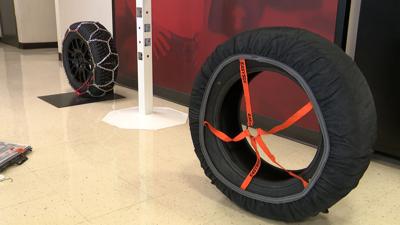
Snow socks are beginning to gain traction as an alternative to chains.
“It's simply like stretching a sheet over a bed,” says Jordan Savelli, assistant manager for the Les Schwab off Kietzke Lane in Reno.
AutoSock is a major manufacturer of the traction devices, and they say snow socks work by wicking away water and gripping directly to the snow and ice layer.
A big benefit of snow socks is their ease of use.
“You just stretch it over the tire, drive a little bit more and stretch them on the rest of the way,” Saveli says, “compared to a chain, you have to get all these different links and such all lined up perfectly."
For some cars, socks are not only easier than chains, but they might also be the only option.
“If you install a chain on an incorrect vehicle, it can damage the brake lines and cause more of an issue, especially on the snow,” says Savelli.
Double-check your vehicle’s owner's manual for specific guidance on whether chains are applicable.
Since snow socks wrap tightly to the tire, there's minimal risk of damaging anything in the wheel well. However, the socks themselves aren't super durable.
“This is a fabric design,” Savelli says. “There's not a set number of times that you can run it. I would say it would be safe to run the sock around no more than five times."
Generally speaking, snow socks are allowed in Nevada and California. So long as they're labeled properly - and are proven to work - you can use them. Both states allow them whenever chains are required.
“R2 is typically what we see, and that is very common around here. And of course the snow socks will fall into that, and they will be approved,” says Ruth Loehr, the Public Information Officer for the South Lake Tahoe office of California Highway Patrol.
Loehr says snow socks also meet R1 and R3 requirements, but those levels are exceedingly rare.
When you buy snow socks, CHP urges consumers to check the packaging to see if they are approved by Caltrans or the National Highway Traffic Safety Administration (NHTSA).
While CHP has seen plenty of traction devices that aren't up to snuff, Loehr says they haven't seen snow socks fail to work.
“I have not seen them to not work,” she says. “They have been efficient every time I've seen somebody use them."
Ultimately, it is up to the personnel at chain checkpoints to decide if you can pass chain controls.
“That's what it all comes down to, is safety,” Loehr says, “and whether or not you're going to make it through chain control. And of course, we want you to make it through chain control."
Snow socks are generally available wherever you buy tires or chains. Keep in mind that they are priced similarly to chains at most locations.