

Regional wildfires in Washoe County are causing widespread power outages, prompting Northern Nevada Public Health to remind food establishments about steps they can take to protect people from foodborne disease and minimize product losses.
The NNPH Food Safety Program said the biggest food safety concerns during an outage involve potentially hazardous foods, including meat, eggs, dairy products, cooked vegetables and cut melons. These foods generally need to be kept below 41 degrees Fahrenheit or above 135 degrees Fahrenheit to remain safe.
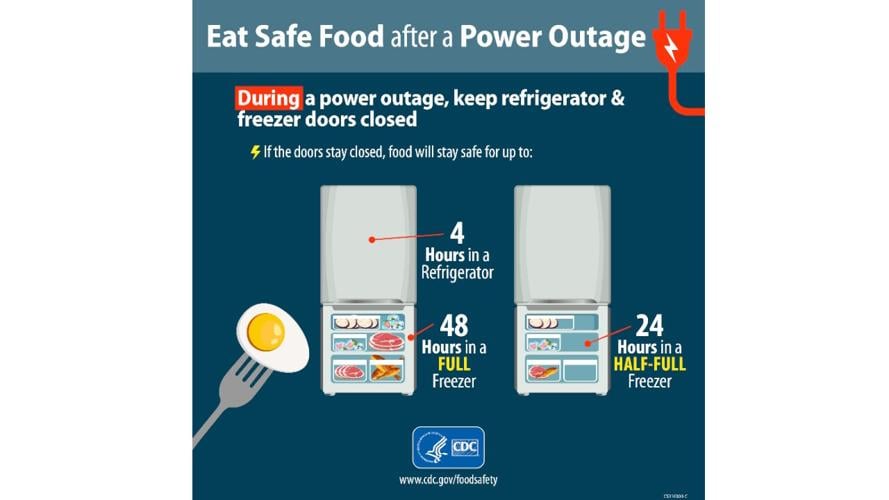
Food establishments should keep track of when an outage begins and keep refrigerator and freezer doors closed as much as possible. When practical, businesses can group packages of cold food, while keeping raw meat away from other food. Open display refrigerators and freezers should be covered, and food can be surrounded with ice to help maintain safe temperatures.
NNPH also warns businesses to stop using gas or solid-fuel cooking and heating equipment if exhaust hoods and make-up air systems stop working. Without proper ventilation, toxic fumes can build up and cause injury or death.
Food that is being cooked when the power goes out should be discarded if it has not reached its final cooking temperature. NNPH's guidance notes that an outage lasting two hours or less is not considered hazardous to food that was being held under safe conditions when the outage began.
For hot food, businesses can use canned chafing-dish fuel under food on electric steam tables to help keep food above 135 degrees. Hot food should not be placed in refrigerators or freezers during an outage.
Businesses should stop preparing food if it cannot be kept at safe temperatures, if there is no hot water or enough water pressure, if utensils cannot be properly washed, rinsed, and sanitized, or if there is not enough light for employees to work safely.
Once power is restored, NNPH recommends checking the internal temperatures of hot and cold potentially hazardous foods. Businesses should then determine which foods can be kept and which need to be discarded. Cold foods that were grouped during the outage should be spread back out so they can cool more quickly.
NNPH provides temperature and outage-duration guidelines for deciding whether food can be sold. For cold foods, items at 45 degrees or below can remain acceptable across the listed outage periods if they were at 41 degrees or less when the power went out and are immediately cooled back to 41 degrees or less. Cold food between 46 and 50 degrees becomes unacceptable after more than four hours, while food at 51 degrees or above is unacceptable after two hours.
For hot foods, items at 130 degrees or above can remain acceptable for up to four hours under the guidance, provided they were at least 135 degrees when the outage began. They should then be reheated to at least 165 degrees and either held at 135 degrees or higher or immediately cooled to 41 degrees or less. Hot food at 129 degrees or below is considered unacceptable after two hours.
Before reopening after a voluntary closure, businesses should make sure unsafe food has been discarded and that hot and cold potable running water is available for handwashing and dishwashing. Lighting, refrigeration, hot holding, ventilation and toilet facilities also should be operating properly.
NNPH says refrigerators should be at 41 degrees or less, electricity and gas services should be restored, and circuit breakers should be properly reset as needed. If a facility was closed by the local health department, it must remain closed until the agency gives official approval to reopen.
For food that must be discarded, NNPH recommends documenting the type and amount of food and the reason it was thrown away. Small amounts can be treated with a cleaning product, such as bleach, so they cannot be eaten before being placed in an outside garbage bin. Businesses disposing of large amounts should contact their garbage disposal company or local landfill operator for instructions.
The full NNPH power outage guidance is available through the agency's Food Safety Resource Library, which also includes other food safety materials.
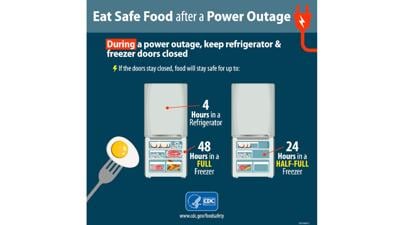
For the general public, NNPH also points to food safety guidance from the Centers for Disease Control and Prevention on keeping food safe at home during a power outage. For the full power outage food safety guidance, including information on food temperatures, disposal and reopening requirements, visit Northern Nevada Public Health’s Food Safety Resource Library.