Space Telescope Rescue

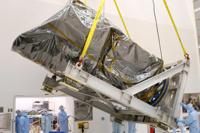
This photo provided by NASA shows an overhead crane raising the Swift spacecraft, wrapped in a protective cover, to vertical before being placed on a work standInside at Hangar AE at Cape Canaveral Air Force Station, in Florida on Sept. 9, 2002.
As featured on
A NASA telescope is barely clinging to space after a failed rescue effort left it tottering lower and lower. The U.S. Space Force predicts the Swift Observatory will come crashing down on or around Friday. Most of the 1 1/2-ton telescope is expected to burn up in the atmosphere. But NASA says a handful of pieces could survive reentry. Swift observed some of the universe's biggest explosions during its 22 years in orbit. Intense solar activity dragged it down faster than expected, prompting NASA to stage a rescue mission. But the robot could not reach the telescope and plunged back to Earth in September.
One of NASA's premier space telescopes has plunged to Earth, ending its 22-year investigation of the universe's biggest explosions. The Swift Observatory's demise on Wednesday came less than three months after a long-shot rescue mission failed. The U.S. Space Force confirmed Swift's reentry near Indonesia after years of tracking its sinking orbit, the result of intense solar activity. NASA hired a private company to whip together an orbit-boosting effort. But the three-armed robotic craft ran into trouble following its July launch and came crashing down in September.
