

The Tahoe Regional Planning Agency (TRPA) Governing Board yesterday unanimously approved a project to test innovative methods to address the largest infestation of invasive weeds in the Lake Tahoe Basin.
An infestation of aquatic invasive weeds in the Tahoe Keys lagoons in South Lake Tahoe is accelerating and poses a serious threat to Lake Tahoe if not controlled, according to TRPA.
The Tahoe Keys Property Owners Association proposed the test project in targeted areas of the 170 acres of waterways. The area is approximately seven times greater than all other Lake Tahoe marinas combined.

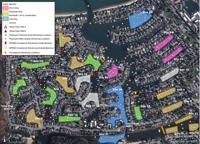
The unanimous board vote clears the path for a combination of weed treatments including ultraviolet light, a one-time application of EPA-certified aquatic herbicides, and a process to aerate the lagoon bottom with small bubbles to reduce plant growth.


A linear bubble curtain helps stop fragments of aquatic invasive weeds from leaving the lagoons
The association worked with scientists, community members, environmental agencies, and non-profit organizations in a multi-year collaborative process that was thorough, scientifically rigorous, and inclusive, the agency said.
“If left unchecked, aquatic invasive weeds in any part of Lake Tahoe threaten our entire ecosystem,” TRPA Executive Director Joanne S. Marchetta said. “With climate change increasing water temperatures, we have an urgent need to deploy science-based solutions to combat these emergent threats.”
Treating the Tahoe Keys lagoons is the number one priority for the multi-agency Lake Tahoe Aquatic Invasive Species Coordinating Committee.
Following failed attempts to control the weeds with conventional methods, in 2017 the Tahoe Keys Property Owners Association applied to water quality agencies for a permit to explore what tools might “knock back” the infestation to a controllable level so it can be maintained by non-herbicidal methods. The environmental analysis determined that Lake Tahoe is not at risk from this test of mixed methods.
“The Tahoe Keys Property Owners Association has been actively managing this weed infestation for over 40 years and has invested millions while the infestation has only gotten worse,” association president David Peterson said. “One method alone is not going to work. For the sake of the entire Lake Tahoe ecosystem, we need to test all tools to address the scale of the invasive species problems in the Tahoe Keys.”
Earlier this month, California’s Lahontan Regional Water Quality Control Board voted unanimously to certify the environmental analysis and issue a special permit for the project. Following the approval, testing and monitoring could begin in cordoned areas of the Tahoe Keys lagoons this spring. Learn more about the project at www.tahoekeysweeds.org.