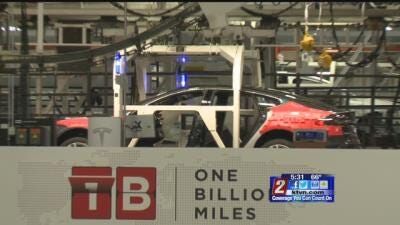

Tesla has been building electric cars since 2007. From start to finish, the cars are almost completely built with American-made parts, right there at the company's Fremont, California factory. However, one of the largest and most important components of the car is built overseas. Panasonic manufactures the battery units in Japan but that will change when the gigafactory is fully operational, at the Tahoe-Reno Industrial Center. Officials say the gigafactory is critical for the future of the company, making Tesla one of the most American-made car brands.
"What you see with a lot of other car companies is that there's a lot of suppliers and in-sourcing from all over the place," Ricardo Reyes, Tesla Vice President of Global Operations said. "Since the architecture of our car is so unique, we've tried to bring it all in-house as much as possible. It creates way higher efficiencies."
Tesla manufactures about 50,000 cars per year. 410 pounds of aluminum makes up 98% of the car. The total weight is about 6,800 pounds - 1,200 pounds of that is the battery unit. The company uses some of the latest technology in its cars in its 5.3 million square-foot factory.
"You walk through this place and it's all clean, the robots are 21st century," Reyes said. "The folks that are working on the floor are in perfect harmony with the robots."
Unlike traditional cars, Tesla does not have mechanical gauges. They have been replaced by screens, including a 17-inch touch screen that controls most of the car's functions, like music and navigation. Even the car's suspension can be adjusted while the car is in motion. Some versions of the Model S have the ludicrous speed option, that allows the car to go 0-60 mph in as little as 2.8 seconds. Most models can go as fast as 155mph, running on electricity.
"We started with everything that's available today, to build a better vehicle," Reyes said. "There's no way you would start a company, today, and build gas-powered cars."
Reyes says electric cars are the future of automotive manufacturing. Some of Tesla's cars can go 270 miles between charges, depending on some variables like temperature and energy usage.
"There are a lot of variables, just like when you run your phone for a long time or you have a lot of apps running at the same time, it uses up more energy," Reyes said. "Same kind of concept."
These electric cars are also similar to smartphones when it comes to charging them. Superchargers can refill half of the battery in just 20 minutes. At home, it typically charges at a slower rate. Some people even use solar power to charge their cars.
"You should be able to wake up and if your car's been charging, overnight, just like your phone, you wake up to an equivalent of a full tank of gas," Reyes said. "You don't burn any fossil fuel."
Reyes says avoiding the gas pump is just one of many benefits of driving a Tesla.
"You don't have to worry about oil changes," Reyes said. "You don't have to worry about going for smog checks. All that is eliminated, as well, and with a lot less moving parts in the mechanics of the car, there's a lot less chance of things breaking or going wrong."
The Model S starts at a price of about $70,000 and the Model X SUV has a base price around $75,000. Reyes says the company did not set out to build a high-priced, premium car, but rather a highly technological mode of transportation. As the price of the technology goes down, Reyes says the price of the car will become more affordable. The Model 3 will be available in 2017, starting at about $35,000. The gigafactory is expected to play a role in the lower prices, possibly dropping the cost of the battery units by 30%.
"We started at a super high technology load and what we fully expect is the price point to come down," Reyes said. "So, Model 3 is the next step in building increasingly affordable cars."
