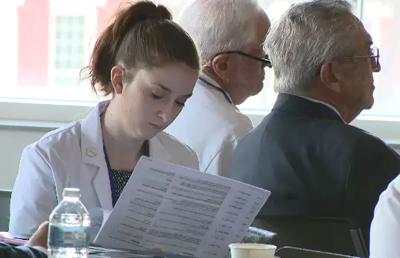




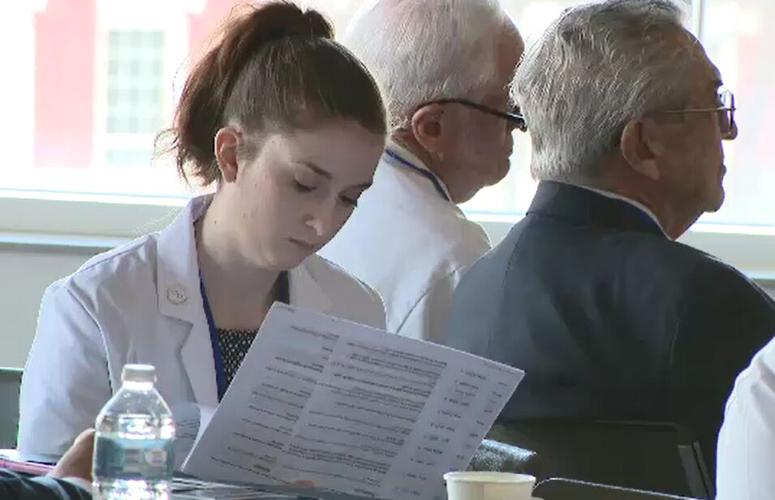
Monday was "Physician Day" at the Nevada Legislature. Doctors, medical students and other health care professionals met in Carson City to talk to lawmakers about some of the biggest medical issues facing our state. One of those issues continues to be opioids. The legislature added restrictions to prevent the over-prescribing of opioids in 2017.
Now, doctors are hoping to make some changes to the law.
"We're hearing a little bit, now, where patients who do have chronic pain are having difficulty getting opioids, so they're having to live with chronic pain," Dr. Andrew Pasternak, Silver State Center for Family Medicine said. "So I think we need to find that right balance."
According to the Centers for Disease Control and Prevention, 70,237 Americans died of drug overdoses in 2017. More than 700 of those happened in Nevada, and opioids caused the majority of them.
Officials are talking to lawmakers about a lot of other issues, including the cost of treatment, insurance and doctor recruitment and retention.
"Health care is obviously a big issue in Nevada, right now, and I think it's really important for our physician community to get involved and really talk about what we can do to improve the health for Nevadans," Pasternak said.
"This is a legislature that really cares about health care, so there's a lot of opportunities for physicians to weigh in," Catherine O'Mara, Executive Director of the Nevada State Medical Association said. "We just want to make sure our voice is heard."
O'Mara says along with opioids, she is hoping to establish a maternal mortality review committee.
"Instances of maternal mortality or death of the mom between pregnancy and the first year of life are on the increase in the United States, and so we want to study that in the state of Nevada and try to inform some best practices," O'Mara said.
Nevada ranks fourth to last for the number of doctors per capita. For every 100,000 people, Nevada has just 200.1 practicing physicians. The median is 257.6 doctors per 100,000. Our state would need about 1,690 additional doctors just to be in the middle of the pack. Pasternak says lifting some restrictions could help get more doctors into the state. That could include changes to malpractice and reimbursement policies.
"It's trying to do things to make it where we make it a friendly environment for physicians to practice," Pasternak said. "Another big thing is always trying to make sure that we're investing in our education."
O'Mara says some restrictions are a burden on doctors, and they can keep them from maximizing their time with patients because they are doing paperwork or working on electronic records. She also says increased federal and state funding for medical schools and residencies could help with Nevada's doctor shortage.
"It takes seven years to grow a physician in primary care and more years of their specialty," O'Mara said. "So we need to continue to invest in those residency programs to keep them here."
Brandon Conner is a first-year medical student at the University of Nevada. He says having more residency programs could also help solve the problem. According the the UNR School of Medicine, 54% of doctors who complete their residencies in Nevada, stay in the Silver State.
"I'm kind of interested in emergency medicine and I know there's not necessarily a residency here for that, so maybe having that opportunity would keep a lot of people like myself in the state because I absolutely love it," Conner said. "I grew up here and its a fantastic medical school."
Conner says it is nice to see medical professionals working with lawmakers to make that industry better for doctors and patients. With a few more years before he starts his career as a physician, he's hoping laws are shaped to make the health care industry as smooth as possible.
"Really, it all starts from the first year and goes all the way to the fourth year and we need all the support we can get from both politicians, current physicians and everything of that nature," Conner said.