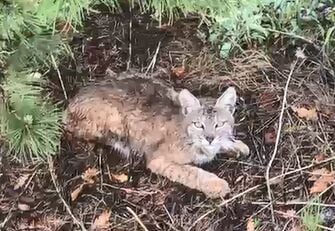


A Reno resident spotted a bobcat in Somersett and got video of the animal as it groomed itself.
It is the second close encounter with a bobcat in a year. Last May, his home security camera caught a bobcat on camera as it attacked a rabbit in his backyard. The Nevada Department of Wildlife says these types of sightings are getting more common in areas along the urban interface.
"Bobcats are becoming a lot more common within urban areas," Jessica Heitt, NDOW Urban Wildlife Educator said. "Definitely, not quite like coyotes that are running around the streets during the day or anything like that but we are having more bobcats on the outskirts of town being sighted throughout the area."
Bobcats, like coyotes, usually go into these neighborhoods to find food and water.
"We have lots of sources of food and water," Heitt said. "It's very dense prey here. Anytime we feed birds or anything like that, that's going to attract other small mammals that provide a really good source of food for these predators."
People living in those areas are reminded to keep an eye on their pets. Bobcats typically prey on rabbits and rodents but they could also go after small dogs and cats.
"Keep your cats inside, keep your dogs on six-foot leashes, keep them close to you and just keep a watchful eye," Heitt said.
Heitt says bobcats are not much of a threat to humans. Still, people are encouraged to stay away from the animals.
"Just kind of walk away slowly, keep your distance," Heitt said. "You can scare it off if you feel threatened but as long as you back away, it will usually leave you alone."
Sightings of bobcats and mountain lions tend to increase during the spring and summer months. Experts say that is partly because more people are outdoors, increasing the probability that they will see wildlife that they normally wouldn't. Newer technology also plays a role.
"They've always got a phone or a video camera on them so they're able to get those pictures and share it on Facebook and a lot more people are going to hear about it, so it seems like there are a lot more sightings and interactions," Heitt said.
Heitt says about 10,000 bobcats and 2,000 mountain lions live in Nevada. Bobcats live in habitats where there is brush for cover. Both species of cats tend to stay away from humans.
"They are very elusive," Heitt said. "Neither mountain lions or bobcats like humans very much. They don't want to interact with us. Mountain lions, especially, are very secretive."
Residents have also reported seeing mountain lions in the same area but they usually follow the deer herds for their food. There has not been a cougar attack on a human since the early 1990s but that person was able to fight it off and survived. Heitt says mountain lions are more likely to attack someone who is running or biking. A cougar attacked two cyclists in Washington last weekend, killing one of them, but attacks are very rare. They are most active during the early mornings and evenings. People who like to hike or bike in the wild are encouraged to go with a partner and carry an air horn, stick or other weapon to scare a mountain lion away.
"With mountain lions, you are supposed to fight back," Heitt said. "Never run from an animal. When you run from an animal, it makes you look like a source of prey and it just triggers that instinct to chase."
While some residents have spotted more than one wildcat traveling in the same place, they usually wander alone.
"Both mountain lions and bobcats are solitary, so the only time you'll see multiple is with kittens or a very brief period when they are mating," Heitt said.
Ali Sakallioglu