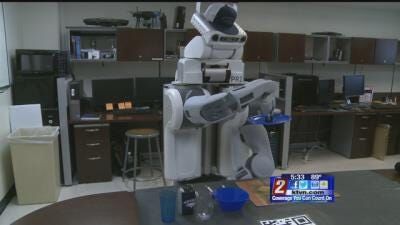
It's a Friday morning in the robotics lab at the University of Nevada and Ada is dusting. She's just over 5' tall. and she sees a duster and understands how to use it.
"We are trying to teach them perception. So they need to learn all that's needed to accomplish something, all the steps," says Monica Nicolescu who runs the department.
"And as much as the steps we want them to perceive what's next. What is the next logical step?" adds Miercae Nicolescu. He works with computer visualization. "They need to recognize what they are seeing and understand it and process it," he says.
These humanoids, Baxter and Ada were purchased with grants from the Office of Naval Research, which hopes someday to use that perception to use for defense with foreign ships. But for now every small step is a leap toward the future at the Nevada campus.
"I thought I'd have to go to California to find a program like this," says robotics and computer science student Jamie Poston. "But they have everything right here. And it's so amazing to see the industry and all its changes in real time here."
As we chat Baxter is across the room, working on a Rubik's cube. They say it may be a few more months before he can solve a major scramble but he's pretty good at minor ones now. And that is thrilling to Houston Lucas who's working on that project.
"It's frustrating when they don't get it. But when they do get things, it's great. I mean everyone doesn't understand it but I know that it took hundreds of hours to make it happen and to get it to work! And it's such an accomplishment."
The program there is moving forward one step at a time and they hope someday to see their technology in manufacturing like all of the high-tech plants going in around Storey County and even in helping with household chores and with healthcare.