Consumer prices probably jumped in May for the third straight month, heightening concerns for the inflation fighters at the Federal Reserve and underscoring the threat rising costs pose for the Trump administration as midterm elections near. Inflation is expected to reach 4.2% in May from a year earlier when the Labor Department reports last month’s figures Wednesday, according to a survey of economists by data provider FactSet The annual increase would be up from the 3.8% reading in April. On a monthly basis, prices are forecast to have risen a hefty 0.5%, slightly below the 0.6% increase in April.
The U.S. military says it has carried out strikes against Iran following the crash of a U.S. Army Apache helicopter off the coast of Oman that U.S. President Donald Trump blamed on the Islamic Republic. A U.S. official who spoke to The Associated Press on condition of anonymity because they were not authorized to discuss an ongoing investigation said Tuesday that the helicopter went down after colliding with an Iranian drone. It wasn’t clear whether the collision was intentional. Iranian Foreign Minister Abbas Araghchi said Iran “will leave no attack or threat unanswered.”
Another sudden reversal for high-flying artificial-intelligence stocks sent Wall Street reeling. The S&P 500 fell 0.3% Tuesday after careening between an early gain of 1% and a midday loss of 2.3%. The Dow Jones Industrial Average edged up 0.2%, and the Nasdaq composite sank 1%. Indexes swung lower after companies selling computer chips, memory and other building blocks of the AI boom broke from early gains to losses. The drops for AI stocks drowned out the benefit of lower oil prices, and most stocks in the S&P 500 rose. Treasury yields edged lower in the bond market.
Wall Street held steadier and recovered some of its sell-off from last week. Oil prices, meanwhile, rose Monday following fighting between Israel and Iran, but they pared their biggest gains. The S&P 500 added 0.3%, coming off its 2.6% drop from Friday that was its worst since October. The Dow Jones Industrial Average dipped 0.2%, and the Nasdaq composite climbed 0.9%. Some of the best performers were companies that sell computer chips, memory and other products fueling the AI boom. They had plunged Friday amid worries that their prices had shot too high amid AI euphoria.
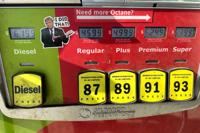
FILE - A customer prepares to pump diesel fuel at this Madison, Miss., Sam's Club, Tuesday, May 24, 2022. (AP Photo/Rogelio V. Solis, File)
FILE - "Buy one Get one" sign is displayed on a product at a grocery store in Schaumburg, Ill., Thursday, May 14, 2026. (AP Photo/Nam Y. Huh, File)
The U.S. stock market had its worst day since October as a sell-off in big technology companies weighed down the broader market. Bond yields surged as a strong jobs report boosted expectations that the Federal Reserve will be forced to hike interest rates at some point this year. The S&P 500 slumped 2.6% Friday, finishing with its first losing week in the last 10. The Dow Jones Industrial Average fell 695 points, or 1.4%. The Nasdaq composite fell 4.2%. Nvidia and Broadcom were among the heaviest weights on the market. The Labor Department reported that employers added 172,000 jobs in May, roughly double what forecasters had expected. Oil prices fell.
U.S. employers added a surprising 172,000 jobs in May as the labor market continued to show resilience in the face of rising costs from the Iran war. The Labor Department reported Friday that job growth was down slightly last month from a revised 179,000 in April. The unemployment rate stayed at a low 4.3%. The job market has been recovering this year from a miserable 2025, so far shrugging off higher energy prices and increased economic uncertainty since the United States and Israel attacked Iran in late February.
Local governments added 55,000 workers, restaurants and bars 48,000, healthcare companies 35,000.
The average long-term U.S. mortgage rate eased this week from its highest level in nine months, welcome relief for prospective homebuyers. Mortgage buyer Freddie Mac said Thursday that the benchmark 30-year fixed rate mortgage rate fell to 6.48% from 6.53% last week. The average rate remains below 6.85%, where it was a year ago. When mortgage rates decline they give homebuyers more purchasing power. Mortgage rates are influenced by several factors, from the Federal Reserve’s interest rate policy decisions to bond market investors’ expectations for the economy and inflation.