President Trump, congressional leaders show no signs of ending shutdown soon.
President Trump and congressional leaders aren’t expected to meet again soon.
Congress has no action scheduled Thursday in observance of the Jewish holy day, with senators due back Friday. The House is set to resume session next week.
The Democrats are holding fast to their demands to preserve health care funding and refusing to back a bill that fails to do so, warning of price spikes for millions of Americans nationwide. The Kaiser Family Foundation estimates insurance premiums will more than double for people who buy policies on the Affordable Care Act exchanges.
The Republicans have opened a door to negotiating the health care issue, but GOP leaders say it can wait, since the subsidies that help people purchase private insurance don’t expire until year’s end.
“We’re willing to have a conversation about ensuring that Americans continue to have access to health care,” Vice President JD Vance said Wednesday at the White House.
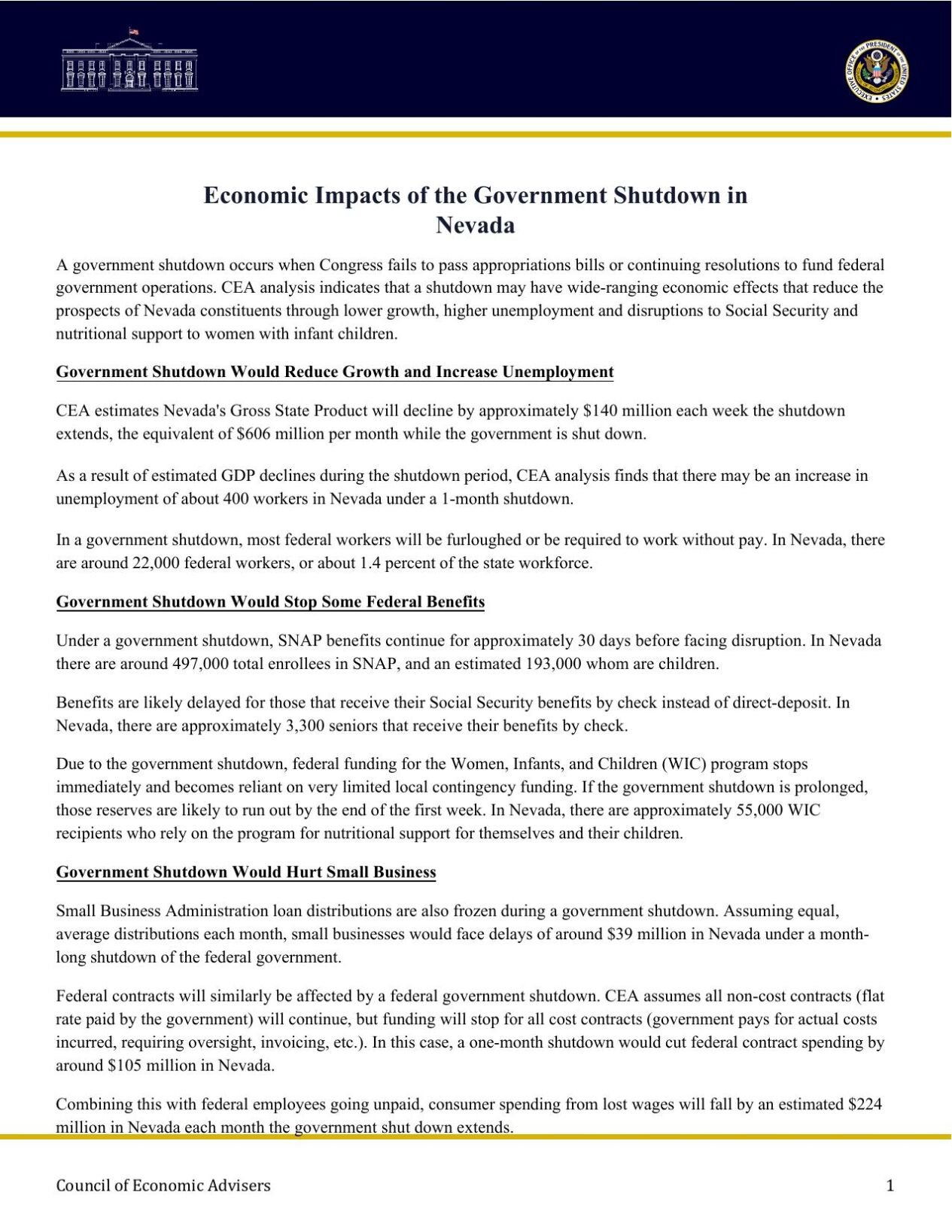
Nevada impacts
Federal employees in Nevada are feeling the effects of the shutdown. There are about 22,000 federal workers in the state, most of whom will be furloughed or required to work without pay.
Social Security benefits may be delayed for recipients who get funds by check instead of direct deposit. About 3,000 seniors in Nevada fall into this category.
SNAP benefits will continue for roughly 30 days before potential disruption. Nevada has about 497,000 SNAP enrollees, including an estimated 193,000 children.
Federal funding for the Women, Infants, and Children (WIC) program stops immediately and will rely on limited local contingency funding. If the shutdown continues, reserves are likely to run out by the end of the first week. Nevada has about 55,000 WIC recipients.


The Pyramid Lake Paiute Tribe Council has announced employee furloughs have been lifted – days after initially putting them in place.
How the government shutdown impacts @DeptVetAffairs https://t.co/VDhi26jvsn pic.twitter.com/JmZfF93Nab
— Veterans Affairs (@DeptVetAffairs) October 1, 2025
Nevada National Guard
The Nevada National Guard released a statement regarding the shutdown:
“The federal appropriations lapse is affecting the Nevada National Guard. The Nevada National Guard is more than 90 percent federally funded. National Guard personnel in an active-duty status will remain on duty to maintain military operations, as will other employees working in functions deemed necessary to daily safe and effective operations. Through this lapse in appropriations, we expect negative impacts on various administrative tasks that are not deemed excepted for ongoing missions. The Nevada National Guard and the Department of War will continue to defend the nation and conduct ongoing military operations. It will continue activities funded with any available budgetary resources that have not lapsed, as well as excepted activities such as those necessary for the safety of human life and the protection of property.
The most recent appropriations for the Department of War expired at 11:59 p.m. EST on September 30, 2025. Active Guard and Reserve (AGR) personnel and federal technicians will continue in a normal duty status without pay until such time as a continuing resolution or appropriations are passed by Congress and signed into law. Federal technicians and Nevada National Guard civilian personnel not engaged in excepted activities have been placed in a non-work, non-pay status.
For your context, the Nevada National Guard is largely a part-time, reserve force. The full-time force is made up of AGR and federal technicians (951 personnel of about 4,400 in the entire Nevada National Guard) or about 22 percent of the entire organization. As it stands, this lack of appropriation will first impact the full-time force and potentially impact future weekend drills, training, and travel for our drill status Guardsmen if an appropriation fails to pass. Units will be able to reschedule drills for later in the fiscal year.
As it pertains to the 951 full-time personnel, 316 full-time federal technicians have been placed on furlough status. As previously stated, the Nevada National Guard’s AGR force (529 Soldiers and Airmen) remains on orders and working during this time. Adding the AGR and excepted federal technicians (106) working through the lapse in appropriation, there are 635 Nevada Guardsmen continuing to work on excepted duties throughout the organization. Accounting for those furloughed, the Nevada National Guard is currently working at about 67 percent of our allotted full-time staff through this lapse in appropriation.”
TSA operations
“Beginning midnight October 1st, funding for much of the Federal Government will have expired due to the partisan politics of left-wing politicians. While it is unfortunate some of our politicians have put politics before the well-being of our country, TSA is prepared for an orderly shutdown.
Approximately 61,000 of the agency’s 64,000 employees are considered excepted or exempt and TSA will continue operations to keep the travelling public safe. The remaining employees will be temporarily furloughed.
While TSA is prepared to continue screening about 2.5M passengers a day, an extended shutdown could mean longer wait times at airports. We kindly ask for our passengers’ patience during this time. Despite this challenge, we will remain vigilant and focused on performing our vital security mission on behalf of the American people.”
Economic impact
Treasury Secretary Scott Bessent told CNBC’s “Squawk Box” Thursday morning that the GDP could take a hit from the shutdown, saying:
“We could see a hit to the GDP, a hit to growth and a hit to working America.”
Data from previous shutdowns show little impact on U.S. GDP unless extended, according to Congressional Budget Office Director Phillip Swagel. “The impact is not immediate, but over time, there is a negative impact of a shutdown on the economy,” he recently told The Associated Press.
No endgame in sight
Thursday marks Day 2 of the shutdown, and already the dial is turned high. The aggressive approach from the Trump administration is what certain lawmakers and budget observers feared if Congress, which has the responsibility to pass legislation to fund government, failed to do its work and relinquished control to the White House.
Vought, in a private conference call with House GOP lawmakers Wednesday afternoon, told them of layoffs starting in the next day or two. It’s an extension of the Department of Government Efficiency work under Elon Musk that slashed through the federal government at the start of the year.
“These are all things that the Trump administration has been doing since January 20th,” said House Democratic leader Hakeem Jeffries, referring to the president’s first day in office. “The cruelty is the point.”
House Speaker Mike Johnson underscored Thursday that the shutdown gives Trump and Vought vast power over the federal government. He blamed Democrats and said “they have effectively turned off the legislative branch” and “handed it over to the president.”
“When Congress turns off the funding, and the funding runs out, it is up to the commander-in-chief, the president of the United States, to determine how those resources will be spent,” Johnson said.
Still, Johnson said that Trump and Vought take “no pleasure in this.”
Trump and the congressional leaders are not expected to meet again soon. Congress has no action scheduled Thursday in observance of the Jewish holy day, with senators due back Friday. The House is set to resume session next week.
The Democrats are holding fast to their demands to preserve health care funding and refusing to back a bill that fails to do so, warning of price spikes for millions of Americans nationwide.
The federal shutdown will cut off vital economic data, including Friday’s jobs report
The government shutdown that began Wednesday will deprive policymakers and investors of economic data vital to their decision-making at a time of unusual uncertainty about the direction of the U.S. economy.
The absence will be felt almost immediately, as the government’s monthly jobs report scheduled for release Friday will likely be delayed. A weekly report on the number of Americans seeking unemployment benefits — a proxy for layoffs that’s typically published on Thursdays — will also be postponed.
If the shutdown is short-lived, it won’t be very disruptive. But if the release of economic data is delayed for several weeks or longer, it could pose challenges, particularly for the Federal Reserve. The Fed is grappling with where to set a key interest rate at a time of conflicting signals, with inflation running above its 2% target and hiring nearly ground to a halt, driving the unemployment rate higher in August.
▶ Read more about the shutdown and economic data
(Copyright 2025 The Associated Press. All rights reserved. This material may not be published, broadcast, rewritten or redistributed without permission.)