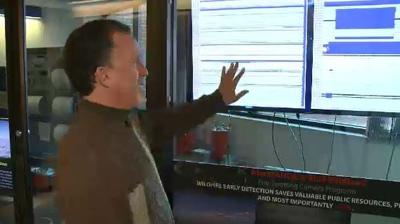

While fault lines were triggering each other one by one outside of Hawthorne Wednesday night, Graham Kent, director of the Nevada Seismological Lab monitored a situation he says is typical in Nevada’s earthquake country.
"This is a classic Nevada, eastern California type sequence where we can get multiple earthquakes of about the same magnitude,” said Kent.
The largest magnitude 5.7 earthquake struck at 12:18 a.m. Wednesday morning followed by another just four minutes later. Less than an hour later, a magnitude 5.5 earthquake hit the area. Well over 100 aftershocks followed. As of Wednesday morning, 16 earthquakes larger than magnitude 3.0 had occurred, including two magnitude 4.0 to 4.1 temblors.
The quakes measured anywhere between five and eight miles below the earth, which is an average depth for an earthquake swarm like the ones on Wednesday. Because they were deep, they could be felt more widespread. More than 10,000 Nevada and California residents felt the events and posted responses to the USGS “Did you feel it?” website. Reports of tremors from as far as Las Vegas and San Francisco were reported.
"There's a lot of energy released in a magnitude 5.7 earthquake. It is not a small event."
This swarm of quakes being in such a scarcely populated area brought reports of only minor damage and no injuries. If it were to happen in a city like Reno, this would have been a much different story.
“Had that sequence been underneath Reno, we would be talking billions of dollars in damage."
Wednesday’s swarm is not something that has seismologists scratching their heads, but is a chance to remind the community that earthquakes cannot be predicted, but rather, prepared for.
“The question everyone wants to know, is there going to be a larger one and that we don't know, but historically in Nevada, we've seen trends where that can be the case…We just have to keep our heads up and prepare.”
For more on earthquake preparedness, click here.
To better monitor the evolving sequence, members from the Nevada Seismological Laboratory, working with the Nevada Division of Emergency Management, California Office of Emergency Services, and the USGS, are investigating access to this remote region, including a snowbound communications site outside of Hawthorne that is critical for establishing radio links for portable stations that could be deployed to better monitor the sequence.
