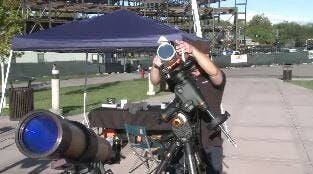
What draws a crowd of astrophysicists, planetarium folk and astronomers together? The transit of Mercury that occurred early Monday morning! They gathered at the University of Nevada, Reno with high-powered telescopes equipped with solar filters.
"It's very exciting anytime we get public interest in what we do it's cool. And it's not something that happens all the time so this is a pretty neat thing," says Melody Rodrique, who is an astrophysicist at UNR.
"It is fairly rare. I mean it happens about 12 or 13 times in a century," said Tony Berendsen with Tahoe Star Tours.
When a planet transits our sun, it causes the sun to dim every so slightly. NASA plans to use the measurements taken today to calibrate equipment for future NASA missions. And in their continuing search for exoplanets...those circling other stars. But today's solar ballet offers us all a little something else too.
"Perspective. I mean here we are on this little dot going around the sun and this gives us some perspective," Rodrigue added.
Mercury will transit the sun again in three years but we won't be able to see it. Our next chance to see it will be in 2032.
