

UPDATE, October 2021:
Tribal lawyers are asking a U.S. judge in Nevada to reconsider her earlier refusal to block digging at a proposed lithium mine near the Oregon line.
They say newly uncovered evidence proves it was the sacred site of a massacre of dozens of Native Americans in 1865.
The new motion filed in federal court in Reno includes an 1865 newspaper report and two eyewitness accounts of how at least 31 Paiute men, women and children were “murdered by federal soldiers” at Thacker Pass.
One was from a cavalry volunteer who participated in the slaughter and the other by a tribal member who survived it.
This comes after another proposed lithium mine in Southern Nevada faces a legal battle over a rare wildflower that only exists in one spot near the planned site. You can find information on that one here.
(Copyright 2021 The Associated Press. All rights reserved. This material may not be published, broadcast, rewritten or redistributed without permission.)
Original Story, March 2021:
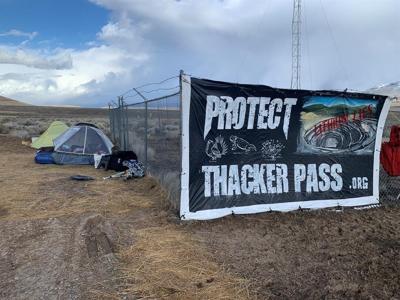
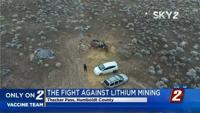
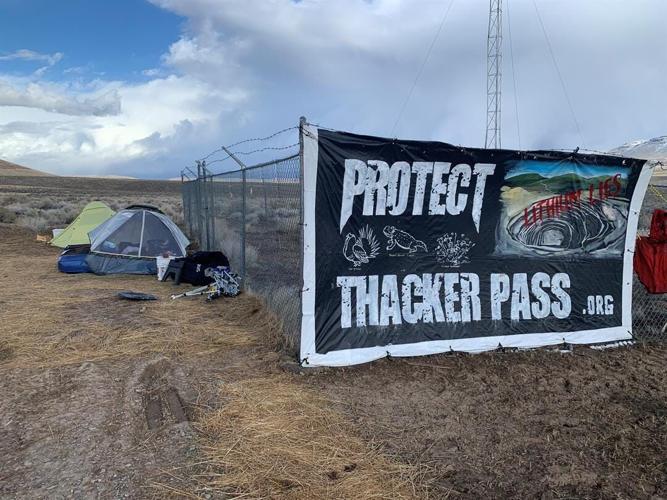
A lithium mine is on the verge of opening in the desert of Humboldt County. Thacker Pass is about 20 miles east of Orovada, north of Winnemucca. Since January 15, environmental activists have been camping at the proposed mine site to keep it from opening.
"The first reason we came out here is simply, we love this place," Will Falk, Member of Protect Thacker Pass said. "It's been amazing. The stars every night are incredible out here. The snow and the wind at first were rough but we made it."
A handful of people are camping at the site. Falk says more than 100 people have circulated through since they started their venture. About 30 people are there on weekends.
The proposed lithium mine is part of the McDermitt Caldera. A super volcano created the lithium deposit there 16.3 million years ago. It is the largest known deposit in North America. Lithium is a critical mineral for clean energy storage but the protesters say do not want to trade green energy for an open pit mine.
"So many of us in the environmental movement understand taking a mountain top off for coal is bad," Falk said. "Well, taking a mountain apart for lithium is bad, as well."
Lithium Nevada already has it's permits from the Bureau of Land Management to start mining the public land. It is expecting to get its final state permits by the end of 2021.
"We're really close," Tim Crowley, Vice President of Government Community Affairs for Lithium Nevada said. "We've been working on this project for over 10 years, collecting data, doing the geology, working with the communities."
Lithium Nevada says Thacker Pass could have a 46 year mine life, create 300 jobs and produce 3.1 million metric tons of lithium carbonate equivalent. Lithium is a key mineral in batteries for electric cars and other equipment.
"Nevada has the opportunity now to be a world leader in the lithium battery ion space and this project is a key piece of that," Crowley said.
The company completed its 12-month environmental impact statement in January. It is working on its engineering and financing plan while it waits for the green light to begin operations. Crowley says he is surprised that an environmental group is protesting a project that enhances green energy.
"I respect their right to protest but consider what they're protesting," Crowley said. "They're protesting the expansion of electric vehicles and lithium batteries for home energy storage. Those are two things that will profoundly bring down the country's carbon footprint."
"I think too many people think that electric cars are going to solve all our environmental problems and in reality, they're just going to cause more," Falk said.
The members of Protect Thacker Pass are not interested in creating better clean energy technology. They say people should rely on less technology like they did before the Industrial Revolution.
"Human beings can get along fine without cars," Falk said. "We evolved to walk places. It's what our body needs. So I think that's the kind of transportation we need to get back to."
Falk says horses would also be useful in some circumstances. Others in the group want to take it a step further and change the future of our homes by looking at the past.
"Construction should be earth dwellings that remain about 60 degrees, year-long," Mato Wokfape, Regional Leader for the Pacific Northwest of American Indian Movement said. "The Mandan built with earth. The Dene built with earth. So my opinion is we should be building with earth."
The protesters have two small camps set up. One of them includes a teepee. They use wood for fires, propane stoves for food, tents and cars. They put straw on the ground to help deal with mud. Residents of nearby communities and the Fort McDermitt Indian Reservation are helping to provide them with supplies.
Along with the technological impacts, they are concerned about the impacts to the public land at Thacker Pass.
"This is a beautiful old-growth sage habitat," Falk said. "This is some of the best sage grouse habitat left on earth. There are pronghorn antelope that move through here. There's really endangered Lahontan Cutthroat Trout up in the streams above these hills."
"I don't think it's a very good idea for them to destroy or do anything to our Mother Earth, here," Myron Smart, Resident of the Fort McDermitt Paiute-Shoshone Reservation said.
Loyd Sherburn is a rancher who lives just a few miles down the road. He is a partner of the Home Ranch, established just northwest of Orovada in 1873. The ranch has 1,500 head of cattle that graze on 6,000 private acres and 450,000 acres of federal land. He is selling some of his water rights to Lithium Nevada.
"We have definitely made an agreement with them to get them water out of the valley off of our farms, that we're going to shut the wells down on when they take over the water," Sherburn said.
Sherburn says he is fine with the mine moving in as long as it takes care of transportation and other logistical issues.
"I'm not against it," Sherburn said. "I just want to make sure that it's put in properly, environmentally sound, and logistically we need to figure out where the traffic's going to go."
Sherburn says some of the community members have other concerns about possible groundwater contamination, noise and smell.
"It's all right to do it in your backyard but not my backyard," Sherburn said. "I think there's a lot of that kind of mentality here."
Lithium Nevada says it is working to address all of those concerns. It is working with residents of Orovada, Kings River and the Fort McDermitt Paiute-Shoshone Tribe.
Crowley says the United States produces about one percent of the world's lithium. Most of it comes from Australia and South America but China processes it to be used into batteries. Crowley says Thacker Pass could replace the current convoluted supply chain and allow Nevada to mine, process and manufacture all within the state.
"Changing that supply chain dramatically reduces the carbon footprint," Crowley said. "At the same time, we're creating 300 great jobs, we're helping the state of Nevada recover from an economic downturn and we're strengthening the United States that depends, currently, mostly on China for the chemicals that we need."
Domestic lithium is also expected to help reduce America's reliance on fossil fuels.
"This is a really exciting time for us to be able to create our own energy independence and be able to secure the green energy future of not only Nevada but the United States," Tyre Gray, President of the Nevada Mining Association said.
Some estimate Thacker Pass could provide 10 percent of the world's lithium. Crowley says that is hard to determine because demand is growing so fast. The world's supply of lithium is already stretched.
"We also know that every major car manufacturer is moving towards complete EV, electric vehicle production," Crowley said. "That demand curve is expected to triple or more by 2025. That's just around the corner."
Lithium is most common in groundwater and hard rock. Thacker Pass is unique because it is concentrated in the clay near the earth's surface so it will not require much blasting.
"It stayed intact and it stayed shallow, so we're not going mine very deeply," Crowley said. "At most, 400 feet."
Despite the protests, the project is expected to move forward. Gov. Steve Sisolak and former Gov. Brian Sandoval have both shown support for the mine. Crowley says it would be the largest-scale project and most advanced in the U.S.