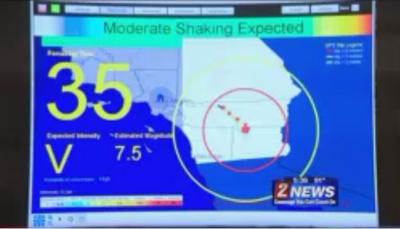
The University of Nevada will receive about $200,000 after the US Geological Survey awarded $3.7 million to six universities for the ShakeAlert Earthquake Early Warning System. UNR will use the money to focus on the California portion of its seismic monitoring system near Lake Tahoe. Eventually, it would like to expand the early warning system into Nevada. The system is already being implemented in California, Washington and Oregon.
"If you have enough seismometers out there, and you can locate the earthquake early enough, as that fault is propagating, you might be able to jump ahead and warn people that are in the wake, so to speak," Graham Kent, Director of the Nevada Seismology Laboratory said.
Kent says congress would have to approve funding for Nevada to get the earthquake warning system, and implementation would likely take about five years.
"It's an ambitious project and it's not going to turn on, tomorrow," Kent said. "It's going to take quite some time, years to build out the infrastructure and get it going, just right."
Kent says a large earthquake in northern Nevada could give residents 10-20 seconds to take cover, before the shock waves reach them. Nevada has not had an earthquake higher than a 6.5 magnitude since 1954, when the silver state had four of them. If one of those hit Death Valley, an early warning system could give Las Vegas residents 45 seconds to more than 60 seconds of warning.
"As long as it's propagating towards Las Vegas, it funnels all of the energy into the basin," Kent said. "So that would be a very bad day for Las Vegas. The good news is it's far enough away that you essentially get that large warning."
The early warning system is designed to give people time to take cover, whether that is to drop, cover and hold on, or for people to get away from a building if they are outside. Kent says it could also be critical for future projects.
"If you want to do advanced manufacturing, you want high speed rail, you need to have this infrastructure," Kent said. "You need to start building it sooner than later."
Of course, the effectiveness of ShakeAlert depends on the strength and location of the temblor.
"If you're right above the earthquake zone, there's hardly any warning," Kent said. "That's very tough, but just because you can't give those people warning doesn't mean you should give everybody else no warning."
For now, the university will use funding to feed existing seismometers into the system and upgrade older stations. Kent says it is a first step of a greater goal of getting Nevada in on the ShakeAlert program, to buy time for residents.
"If I can get five seconds, three seconds, ten seconds, I'll take it," Kent said. "So, we can better drop, cover and hold on. If your kind of near a building, you can move away from it."