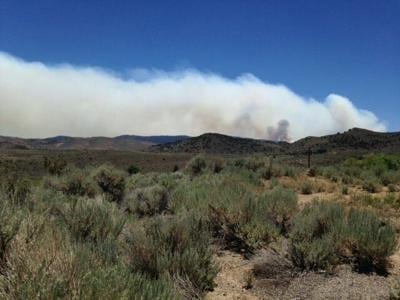
Fire officials tell Channel 2 News that the Washington Fire burning 3 miles south of Markleeville, CA was started by lightning and is still 17,697 acres as of Sunday with containment at 37%.
Highway 4 through Markleeville, south over Ebbetts Pass, reopened for through traffic only on Sunday at 9 a.m. The forest area nearby is still closed. Highway 89, starting at the junction with Highway 4 and continuing over Monitor Pass, is still closed. Wolf Creek Road is still closed due to fire activity in the area.
There is no longer an evacuation advisory in Markleeville or the Grover Springs Hot Springs Campground. The public is able to return to these areas but advised to use caution when driving as the fire officials are still using these roads to travel to and from the fire.
As of Sunday there are about 1,160 personnel including 31 hand crews, 52 engines, 12 water tenders, and 11 helicopters working to put out this fire.
----------
The fire started just after 7 p.m. on Friday in the Silver Creek Drainage area which is 8-10 miles south of Markleeville, California. The Alpine County Sheriff's Office is asking residents in the Markleeville area to prepare for an evacuation. As of now, there is no evacuation order in place but they want residents to be prepared in case one needs to be put into place. The Douglas County Sheriff's Office has sent their Search and Rescue Team to Markleeville to help with evacuations if need be.
Sierra Front Fire says five residences in the nearby area are threatened and have been evacuated. These are not homes in Markleeville. They are believed to be camping cabins. Fifteen historic cabins are also threatened.
Several campgrounds along Highway 4 to the north end of Markleeville have been evacuated. In addition, Highways 4 and 89 in the Monitor Pass area are closed. Turtle Rock and Indian Creek campgrounds are closed. As a precaution, Markleeville residents have been advised to prepare for an evacuation if the need arises, however, no mandatory evacuations are in effect for Markleeville at this time.
The Carson City Health and Human Services says air quality is at the 'moderate' level in the Carson City area due to the lighting-sparked Washington Fire burning south of the city.
The Alpine County Sheriff's Office tells Channel 2 that a 61-year-old Carson City man was taken into custody near the Markleeville Heliport and released with a citation for Entering a Closed Fire Area. Deputies say they believe he was going to hike into the fire with a shovel to help with suppression efforts.
One minor heat-related injury occurred. Once removed from the fireline, the firefighter was treated and is doing fine.
Firefighters plan to continue direct line construction north of Highway 89, as well as utilizing air and ground support. Continuing protection of cultural and historical sites within, and adjacent to the fire area will also be addressed in today's operational period. The tactical priority is to prevent the fire from reaching Markleeville.
The Great Basin Incident Management Team says about 900 personnel are assigned to the fire. Crews will utilize both air and ground support.
Fire crews say that there has not been a fire in this particular area since the 1940's and that some of the timber in the region has not burned for more than 100 years which causes it to burn more aggressively and put up large plumes of smoke.
The National Weather Service says residents near Smith Valley, Mason Valley and Antelope Valley could see dense smoke. They warn that visibility in those areas could be as low as 1/2 of a mile. They say if you need to be outside in those areas to avoid strenuous activities.
High temperatures are forecasted later in the week along with possible thunderstorms that can cause erratic winds.
PETA is offering some advice on what to do with pets in case of evacuations:
• In the event that your area is evacuated, never leave companion animals behind to fend for themselves. They aren't any better equipped to survive disasters than humans are.
• Know your destination ahead of time. Shelters for human victims often don't allow animals, but motels in the area will probably accept them in an emergency. Call destinations in advance, and find out which ones will accommodate you and your animals.
• Never leave animals unsupervised in a car—they can panic and try to escape or suffer from heatstroke once ambient temperatures rise above 70 degrees, even if water is provided and the windows are slightly open.
• Place small animals in secure carriers. Dogs should be leashed with harnesses because frightening sounds and unfamiliar surroundings may make them bolt and strangle. Take water and food bowls, your animal's favorite toy or blanket, a towel, and enough food for at least one week.
• Make sure that dogs and cats are microchipped, and put legible ID tags with your phone number on them so that your animal companions can be found if they get separated from you.
For more information, go to peta.org.
From Mono County:
How to tell if smoke is affecting you
Smoke can cause—
• Coughing
• A scratchy throat
• Irritated sinuses
• Shortness of breath
• Chest pain
• Headaches
• Stinging eyes
• A runny nose
• Asthma exacerbations
If you have heart or lung disease, smoke might make your symptoms worse.
People who have heart disease might experience—
• Chest pain
• Rapid heartbeat
• Shortness of breath
• Fatigue
Smoke may worsen symptoms for people who have pre-existing respiratory conditions, such as respiratory allergies, asthma, and chronic obstructive pulmonary disease (COPD), in the following ways:
• Inability to breathe normally
• Cough with or without mucus
• Chest discomfort
• Wheezing and shortness of breath
When smoke levels are high enough, even healthy people may experience some of these symptoms.
Know whether you are at risk
If you have heart or lung disease, such as congestive heart failure, angina, COPD, emphysema, or asthma, you are at higher risk of having health problems than healthy people.
Older adults are more likely to be affected by smoke, possibly because they are more likely to have heart or lung diseases than younger people.
Children are more likely to be affected by health threats from smoke because their airways are still developing and because they breathe more air per pound of body weight than adults. Children also are more likely to be active outdoors.