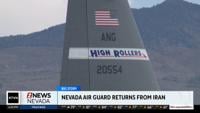

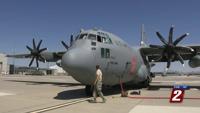

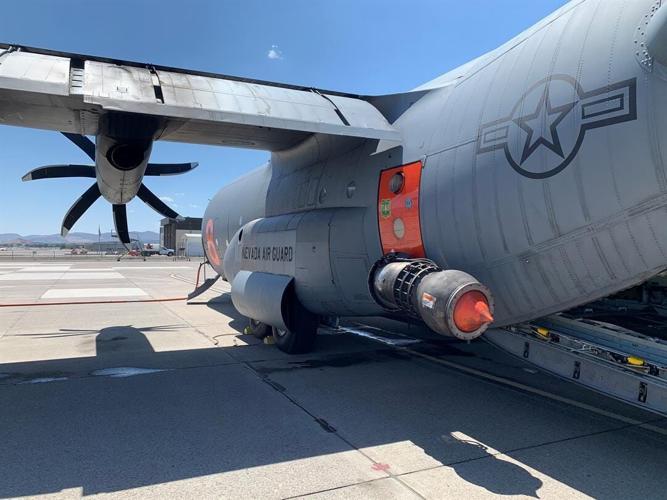
The 152nd Airlift Wing of the Nevada Air National Guard is preparing for its first firefighting activation in two years. The crews will fly their C-130 aircraft to McClellan Airbase in Sacramento where they will wait for their mission.
"Once we receive the Request for Assistance, the RFA, it allows us to integrate with our U.S. Forest Service partnership to help and assist where needed and when called," Maj. Tom Dorsett, 152nd Airlift Wing said.
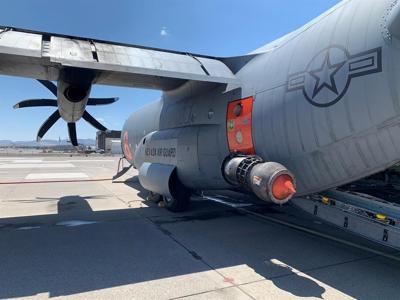
The 152nd Airlift Wing, also known as the High Rollers, will use U.S. Forest Service equipment called Modular Airborne Firefighting System, or MAFFS. The team will deploy Wednesday to help the USFS where needed. They help when the commercial air tankers are exhausted.
"We're kind of that last call to come in there and do what the Forest Service needs us to do," Master Sgt. Jonathan Turner, 152nd Airlift Wing said.
The 152nd Airlift Wing is one of four military units that train and operate on MAFFS missions. It is the second unit to activate this year, along with the 146th Airlift Wing of the California Air National Guard.
The equipment slides into the back of the C-130, essentially converting the planes into air tankers. MAFFS can carry 3,000 gallons of water, weighing 27,000 pounds, spreading it in a line for a quarter of a mile.
"It's able to disperse that within three to five seconds so it's an amazing system that does a very good job," Dorsett said.
Dropping that amount of water also has an effect on the plane, giving it a kick as the load lightens.
"You can instantly feel that," Turner said. "It's just a huge surge in power you get when you drop that much weight and you get so much more power and efficiency out of the airplane."
The High Rollers have been conducting firefighting missions like these since 2016. It had to work with other units until it got enough training. This is the second year it has had the ability to operate on its own. Each crew consists of six people. Four are in the front of the aircraft and two are in the back.
"It's a total team effort amongst the wing. So there's support functions and then operations functions that work hand-in-hand to make sure that we're successful as a unit to do this mission.">
The Air Guard helps with a variety of situations both domestic and around the world. It has helped deliver personnel and supplies to hurricanes and other natural disasters but crew members say nothing compares to fighting fires.
"The terrain and difficult environment is so much more demanding in a fire scenario compared to a hurricane scenario," Turner said.
The crews work with the other military units, training and operating USFS MAFFS missions with the 146th Airlift Wing, the 153rd Airlift Wing of the Wyoming National Guard and the 302nd Airlift Wing of the U.S. Air Force Reserve Command at Peterson Air Force Base in Colorado.
"It's one of the biggest upgrade trainings in the Air Force, MAFFS, and it takes a lot of hours, a lot of years to be able to say you support MAFFS," Turner said.
They admit that these missions are difficult and dangerous but they also say they are also the most gratifying.
"It's amazing and such a rewarding feeling to be able to save someone's property and lives," Dorsett said.