

It started with concern for a small group of wild horses spotted struggling in deep snow and quickly grew into a race to save many more as winter tightened its grip.
According to the U.S. Forest Service Inyo National Forest online post with the latest information, the USDA Forest Service has completed an emergency operation to rescue wild horses stranded by severe winter conditions on the Inyo National Forest.
The situation first came to light on January 15, when the Forest Service said nine snowbound wild horses had been identified outside the Montgomery Pass Wild Horse Territory.
Officials warned the animals were in critical jeopardy due to snow impact, limited water, and extremely limited forage.
As crews continued monitoring the area and conditions worsened, Forest Service staff determined additional horses had moved into the same snowbound terrain.
The agency then expanded the scope of the operation, announcing plans to trap and move up to 25 wild horses to prevent further losses.
Severe winter conditions left the horses with no access to food or water after they became stranded outside their normal range. Many of the animals were visibly emaciated and in poor body condition and would not have survived without intervention, the Forest Service said.
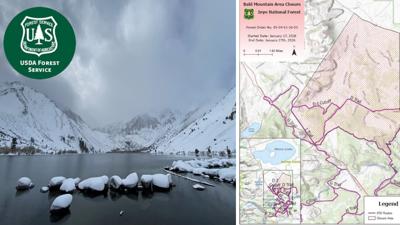
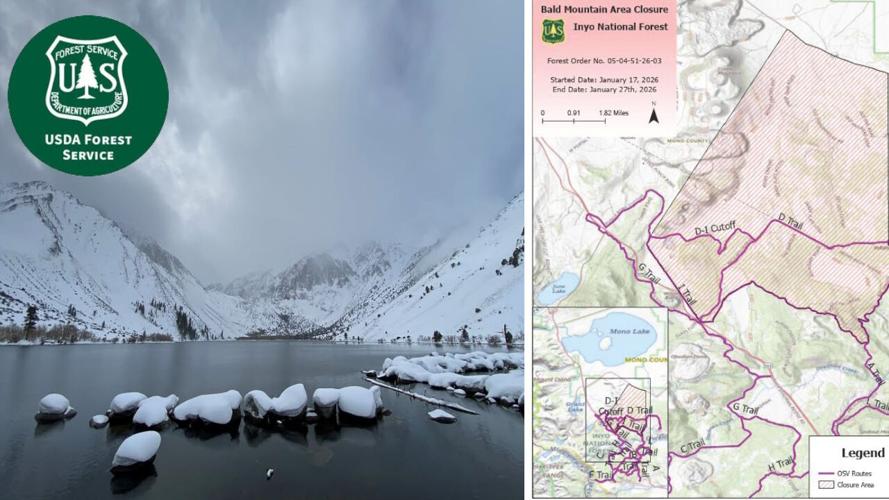
To support the expanded rescue effort, the Forest Service announced a temporary closure of the Bald Mountain area of the Inyo National Forest. An updated release on January 17 said the closure would be effective from January 17 at 9 a.m. through January 27. Going into or being within the closure area was prohibited.
The agency said the bait and water trap method required limited activity because wild horses are reluctant to approach trap sites when there is too much disturbance. Only essential personnel were allowed at the site, and the public was asked not to interfere.
Multiple over-snow vehicle routes were affected by the closure, including portions of Trail I, Trail D, and the I and D Connector Trail. Travel within the closure area was prohibited, and a map was provided showing the affected area.
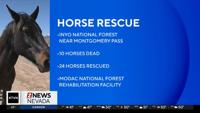
The post says that over the weekend, Forest Service crews worked in snowbound terrain using bait and water traps to reach the animals. A total of 24 horses were rescued and transported to a temporary holding facility in Bishop, California, where emergency care was provided to stabilize them.
Despite those efforts, one horse later died due to extreme emaciation. Three horses were humanely euthanized because of critically poor body condition. Crews also found six horses dead in the forest, with starvation and prolonged exposure cited as the cause.
In the final update released January 21, the Forest Service said staff had stabilized the remaining horses and transported 20 surviving animals to a better-equipped rehabilitation facility on the Modoc National Forest.
The Forest Service said recovery for the horses is expected to take up to 10 months.
The horses are associated with the Montgomery Pass herd, and officials said their movement well outside the herd’s typical range before heavy snowfall contributed to the emergency.
The Bald Mountain closure was expected to be lifted on Thursday, January 22, and the Forest Service said this would be the final update on the emergency wild horse welfare operation.
(The U.S. Forest Service Inyo National Forest contributed to this story.)