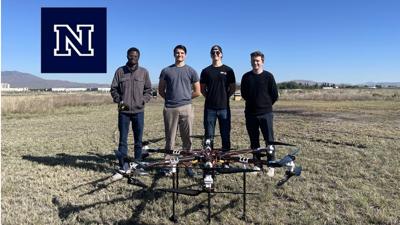
A group of University of Nevada, Reno engineering students is getting ready to put months of work to the test after earning a place in a national competition focused on the future of heavy-lift drone technology.
The five-person Nevada Engineering team, known as Tactical Intelligent Transport for Autonomous Aerial Logistics, or TITAN, will compete in the DARPA Lift Challenge from August 2-9 at the National Museum of the U.S. Air Force in Dayton, Ohio.
The competition, organized by the Defense Advanced Research Projects Agency, offers $6.5 million in prizes and is designed to advance emerging heavy-lift drone technology.
Led by electrical engineering Professor Hao Xu, the team is one of 124 invited teams from small businesses, startups and academic institutions. It is the only Nevada team selected for the competition and was among the first group of competitors announced June 8.
Since February, undergraduate students Owen Kirpes and Cash Walker, along with graduate students Matthew Goecker and Christopher-Jerrell Mengu, have been building the team's prototype. They are also finishing a second aircraft to bring as a backup in case the original experiences problems during the competition.
“I’ve been working with them in the past few months on the project,” Xu said. “This team is very good. They’re working very collectively... this team is very efficient.”
The challenge was announced in a November 13, 2025, news release that stated: “The DARPA Lift Challenge aims to shatter the heavy lift bottleneck, seeking novel drone designs that carry payloads more than four times their weight, which would revolutionize the way we use drones across all sectors.”
Competition rules require aircraft to weigh less than 55 pounds and lift a minimum payload of 110 pounds across a five-nautical-mile course.
According to the team's final concept paper, TITAN's prototype is designed to carry 3.27 pounds of payload for every pound of aircraft weight and can generate a total thrust of 444 pounds.
“Our design is a dodecahexacopter, which means there’s 12 rotors,” Kirpes, who is majoring in aerospace engineering, said. “Each arm is stacked with two propellers, so we have 12 propellers in total. Most of the structure is made of carbon fiber, joined together with aluminum parts, so everything is light and strong.”
Kirpes leads development of the drone's frame and propulsion system. Goecker, who earned a bachelor's degree in aerospace engineering from Embry-Riddle Aeronautical University, designed the wing system and helped improve aerodynamic performance. Mengu developed the drone's electronic systems, including a double-redundant backup power system intended to help the aircraft operate safely.
Walker, a mechanical engineering student and FAA-certified drone pilot, leads systems design and serves as flight director.
During the competition, the drone will fly autonomously along a 1,000-foot course, traveling back and forth 15 times at a predetermined altitude while Walker manages the flight plan, monitors the aircraft, and ensures compliance with FAA rules.
The project has extended beyond the five-member team. Xu estimates research and development costs at about $50,000, with support from the Bean Space Foundation and the Department of Defense center CREDIT+: Advancing Data Analysis for Mission-Critical Applications in the Era of Artificial Intelligence, where Xu is a founding member. The team also conducted flight testing with the Nevada UAS Test Site.
For Xu, qualifying for the competition is about more than prize money.
“There’s going to be a lot of interesting opportunities and fruitful discussions among national partners for us to boost Nevada drone R&D and workforce development,” he said.