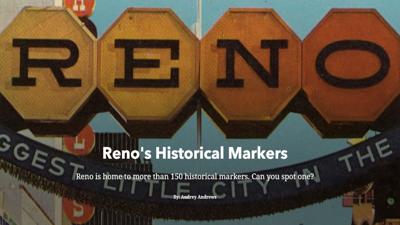

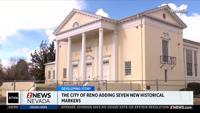

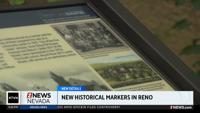

Seven locations throughout Reno recently received historical markers as part of the City of Reno’s Historical Marker Program.
The project was funded through a Nevada Humanities grant approved by the Reno City Council in February, with additional contributions from Reno Mayor Hillary Schieve and Ward 2 Councilmember Naomi Duerr.
The effort is part of the city’s Historic Preservation Program, which began in 1993 to identify and preserve significant local landmarks.
The markers were selected by the city’s Historical Resources Commission and are placed at sites that represent significant moments or themes in Reno’s development.
New additions to the program include:
- California Building, 75 Cowan Drive: Built in 1927 in Idlewild Park for the Transcontinental Highways Exposition. Funded by the State of California, the Mission Revival-style building housed exhibits showcasing California industries.
- McKinley Park School, 925 Riverside Drive: The first of four Mission Revival-style grammar schools constructed between 1909 and 1912. Designed by local architect George Ferris, the building was named after an existing park created following the 1901 assassination of President William McKinley.
- Lear Theater, 501 Riverside Drive: Originally a Neoclassical Revival-style church built in 1939 by architect Paul Revere Williams. The building was later renamed for Moya Lear, who donated over a million dollars for its conversion into a theater, a project that was never completed.
- Douglas Alley, N. Virginia Street near the Arch: Once a downtown corridor lined with back entrances to gambling clubs, cafés, and speakeasies. Much of the alley was lost to later development, and only one block remains.
- Reno City Hall, 1 E. 1st Street: Opened in 1963 as the First National Bank of Nevada headquarters. Designed by Robert Langdon, the building is a local example of international-style architecture and was Reno’s tallest building until 1967.
- Chinatown (site), Lake Street and Tahoe-Pyramid Trail: Recognizes the area where Chinese immigrants settled as early as the 1860s. Despite enduring discrimination, a small Chinatown remained active for decades along the north bank of the Truckee River.
- Washoe County Courthouse, Court Street and S. Virginia Street: The courthouse, completed in 1911, incorporates the earlier 1873 structure. Architect Frederic DeLongchamps earned his first solo commission with the expansion and later completed additional updates in 1946, 1949, and 1963 with partner George O’Brien.
A new printed and digital map guide highlighting the historical markers is now available at the McKinley Arts and Culture Center and Reno City Hall, as well as online on the City’s Historic Markers page.
The City of Reno continues to review and install new markers as funding becomes available.
Historical markers are selected based on their ability to represent unique aspects of Reno’s past not yet covered by existing signage.