

The impacts are still being felt from the 83rd Nevada Legislative Session.
55 new laws from it are now in the Nevada Statutes.
The only one from the 36th Nevada Special Session to ring in the New Year is the Governor's 'tough on crime' bill.
Using A.I. in Political Advertisement
The Silver State will see a general election in November, with some notable races including Governor and Attorney General.
Artificial Intelligence is always top of mind, which brings us to Assembly Bill 73.
If a campaign advertisement uses A.I. or any type of synthetic media, it must clearly state that the media has been manipulated.
If it's a video, it must be shown throughout the whole thing. If it's audio, a disclosure must easily be heard at the beginning and end of it. If the audio clip is longer than two minutes, then it must be played at least every two minutes.
If there's a violation, the person being depicted can sue.
Reproductive Health Protections
Another law, AB176, creates the Right to Contraception and Family Planning Services Act. It protects reproductive health care.
The law says it includes medical, surgical, counseling, or referral services, which include pregnancy care, miscarriage, and in-vitro fertilization.
The Act says it does not include abortion and anything associated with it.
The law states it also protects any procedure or care found by a doctor that is based upon the wishes of the patient and in accordance with state laws.
Abortion is protected in state law. In 2024, it passed on the ballot to enshrine it in the state's constitution. It will reappear on the 2026 ballot, where it needs to receive another vote to officially pass.
More Language Assistance for Voting Materials and Elections
Removing more language barriers is what AB367 is doing.
It requires the Nevada Secretary of State to have voting materials and election information available in languages that are required by federal law.
That partially includes Spanish, American Sign Language, Filipino, and Chinese.
The Secretary of State must create a toll-free number for translation assistance.
Stronger Regulations for Food Delivery Service
AB116 says a platform such as Uber Eats or DoorDash must not allow a business to use its services unless it has obtained a proper business license from its local government.
If a business lies to a food delivery service that it qualifies, it could face a penalty of up to $100 for each order.
The food delivery app would have up to 10 days to remove the restaurant from the platform. If not, it could be fined up to $500 a day.
Getting Homeless People Better Situated
Another new law tackles one of our area's greatest challenges, homelessness.
We've spoken with many advocacy groups, and one of the biggest hurdles is getting those in need identification.
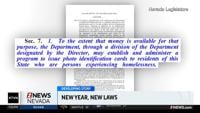
That's what AB220 is trying to tackle.
The law does not require, but it allows the Department of Health and Human Services to create a program to issue IDs to homeless people.
It states it only does if there is money available, and the law allows the department to get grants and donations for the program.
If it's established, the IDs would be similar to the Department of Motor Vehicles, but the IDs would not give the authorization for people to drive.
To get the card, people must be at least 10 years old, live in the state, and not have a driver's license from another state.
The Department would not charge a fee for the IDs, and all personal information would be confidential.
Prison Data for Redistricting
Lastly, AB477 looks to combat prison gerrymandering, which distorts representation by counting those in jail or prison as living where they are confined rather than at their residential addresses.
This new law requires the Department of Corrections to collect records of those in jail and prison, which includes their last known residence if they're an adult, as well as their race and ethnicity.
The law requires that there be data for those being released after July 1, 2030.