






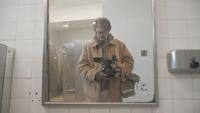


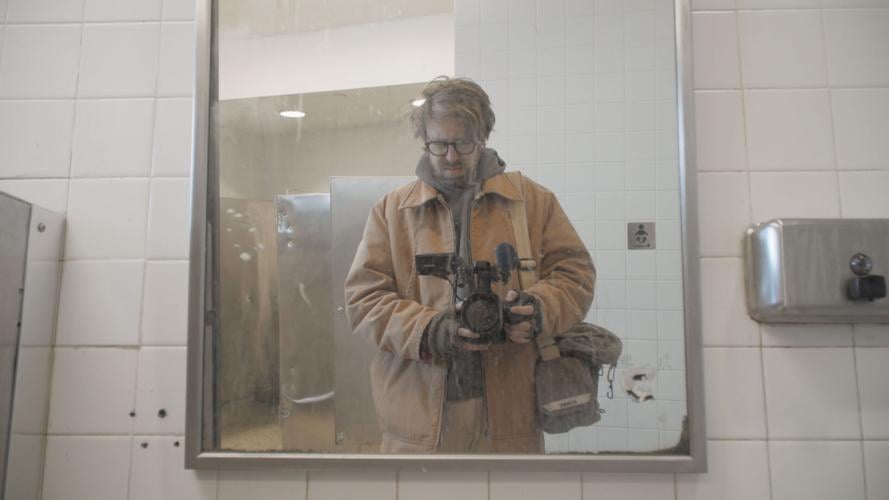
NEW YORK (AP) — Years ago, John Wilson began just walking out into New York with his camera.
Wilson was freshly out of college and eager to establish himself as a filmmaker. But he was naturally timid. It took some gumption to leave his apartment in the Ridgewood neighborhood of Queens and start pointing his camera.
“I did a cappella in college for a little while, and I felt like that was the most embarrassing thing you could possibly do,” shrugs the director of “The History of Concrete.” “Once you do that, you can do pretty much anything.”
What compelled Wilson, 39, is a little hard for him to pinpoint now. He wanted to make movies, and the streets of New York offered free, unlimited production value. He wanted to preserve what was always disappearing: a storefront sign, a moment. Most of all, he wanted to capture the mundane, ubiquitous things around us that go unexamined.
“I think while I’m shooting: What would another film be too afraid to put in? What would another film not have the room for?” Wilson says. “The project of changing the way people see things is never-ending. It’s what art-making should do.”
High art at the Low Cinema
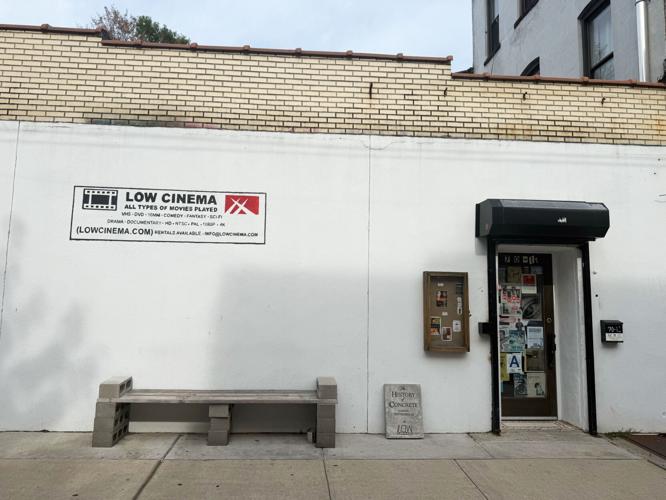
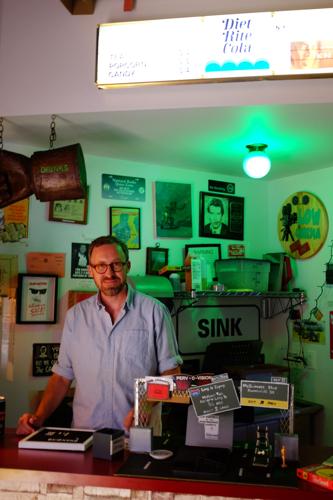
In a blockbuster movie world, Wilson is carving out his own idiosyncratic niche. A year ago, he opened the Low Cinema, which he co-owns, in Ridgewood. It’s a 42-seat micro-theater far off the Ticketmaster map, pieced together with the leftovers of defunct movie theaters. Wilson programs just about anything, much of it on old 16 mm reels. Moviegoers keep turning up.
“People just roll the dice constantly,” says Wilson, sitting in the theater.
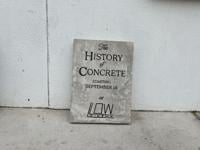
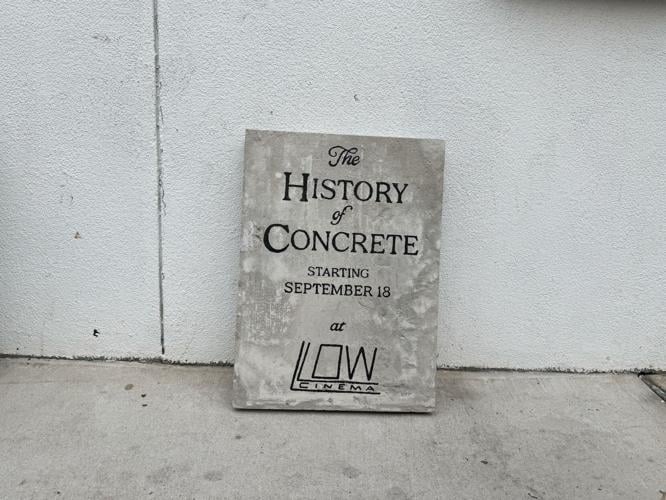
On a recent September day, two “Changing Lanes” were playing — one the 2002 Ben Affleck movie, the other the 2025 bike lane documentary. Wilson arrived that afternoon with a small haul of new VHS tapes: “The Birds,” “Au Revoir Les Enfants” and “Endless Summer II.” Outside, a small concrete slab advertised Wilson’s new movie.
“I opened up this place maybe unconsciously, partially, so I would have a place to premiere my own movie, in case no one wanted to buy it,” Wilson says, smiling. “But that doesn’t seem to be the case.”
“The History of Concrete,” Wilson’s feature film debut, did open in just one theater. But it sold nearly every available seat. Over the weekend, it grossed $90,000 at Manhattan's IFC Center for Magnolia Pictures.
Despite — or maybe because of — Wilson’s resistance to Hollywood's prevailing wisdom, he has grown an entirely organic, authentic and highly personal micro-revolution in movies.
“I always wanted to have something that was mine that felt like no one else could make. I got really jaded by the indie film world after a while,” Wilson says. “I didn’t want to play by any of the same rules.”
Potholes and chance encounters
When Wilson gets a subject in his head — scaffolding, small talk, ear cleaning — that’s only the starting point. From there, he goes places both absurd and existential. The bird-watching episode of his Nathan Fielder-produced HBO series “How To with John Wilson” led him, improbably, to a Titanic replica in Tennessee.
“The History of Concrete” sets out to examine the second-most used substance in the world. (No. 1? Water.) The movie’s beginning was typically humdrum: Wilson’s basement flooded and he struggled to fix it. But it unspools with remarkable digressions, from a tattoo preservationist for the dead to a liquor salesperson and rock musician named Jack Macco.
“That was one of the lowest points, that day we met. I was shooting potholes all day,” Wilson says. “My camera broke. I was in pieces. Then I ran into him at the liquor store and I took my camera out of my bag, and then I ended up spending the next year and a half with him.”
Wilson’s ability to find connection in inhospitable places has become legend. On a “How To” episode shot at spring break in Cancun, Mexico, a chance encounter with a soulful young man named Chris turns into a tender dialogue on social anxiety and grief.
The filmmaker Josh Safdie, a producer on “The History of Concrete,” first met Wilson in Boston in the early 2000s. On a friend's suggestion, he watched Wilson's fiction short about a TV show host (played by Wilson) whose show is going terribly. Safdie saw in Wilson “a humor that hinged on ‘reality’ while at the same time was droll.”
The New York natives recognized a shared interest in uncovering something real and raw in the city through film. Wilson, born in Queens and raised on Long Island, set out with the idea of doing for video what photographers like Weegee, William Eggleston and Daniel Arnold did on the street.
“I feel a deep kinship with John’s voice,” says Safdie. “Life is happening around us all the time. John sees a wire-frame around him that’s warming, funny, life-affirming and poetic.”
How to pitch ‘The History of Concrete’
When Wilson started his movie, he didn’t know where it was going to go. He was curious about how pervasive concrete had become: its effect on the environment and its often dubious durability. But he was also searching, and struggling, to find a foothold following “How To.”
“Concrete” settles into a meditation on permanence, civic life and creativity. Wilson, a little quixotically, is shown pitching his idea for the documentary. His title doesn’t exactly wow executives. If concrete often smothers the life under it, something similar, the documentary suggests, is happening in culture.
“It’s better to look at reality and try to make stuff that’s about the reality we all exist in,” says Wilson. “I believe in movies of the moment.”
That involves sometimes letting himself be pushed into odd places, including a surreal trip to a concrete industry convention.
“Anytime people have the confidence to tell you what the right idea is, I tend to gravitate toward that,” Wilson says, smiling. “Even if it’s a cursed proposition.”
Wilson is just ‘shooting what's out there'
Wilson looks at some of today's pervading approaches to filmmaking with a skeptical eye. A historical epic that costs $200 million to make? “I find it kind of silly you have to spend that much money to say something,” he says.
Meanwhile, Wilson keeps going out and shooting. He’s working on a new long-form project and possibly another episodic one. “But as of now,” he says, “nothing is real and I’m just shooting what’s out there.”
“But once you sit down in front of this mountain of material, everything is fair game,” he says. “A movie can be whatever you want, and that’s what’s so fun about it.”
The explanation makes Wilson think of something in the small lobby of the Low Cinema. Hanging in the corner, near a poster for Frederick Wiseman's “City Hall,” is a slightly crude but not unimpressive cardboard E.T. A sticker on the bottom reads: “Made by humans not AI.”
“I never made a sculpture like that. I just had a bunch of cardboard and Elmer’s glue. Just making something — even if it’s the most poorly made thing — by the end of it, you have a product,” Wilson says. “And maybe you really like it.”