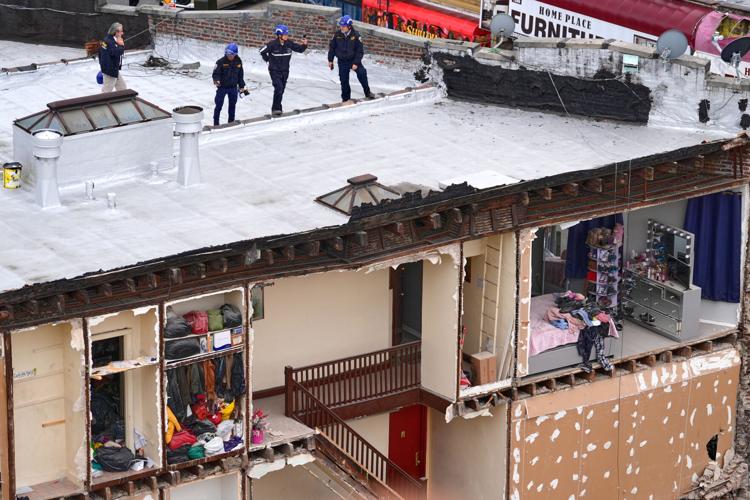


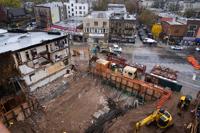

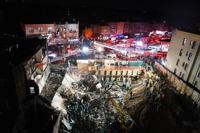

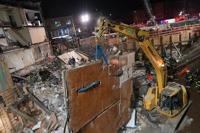
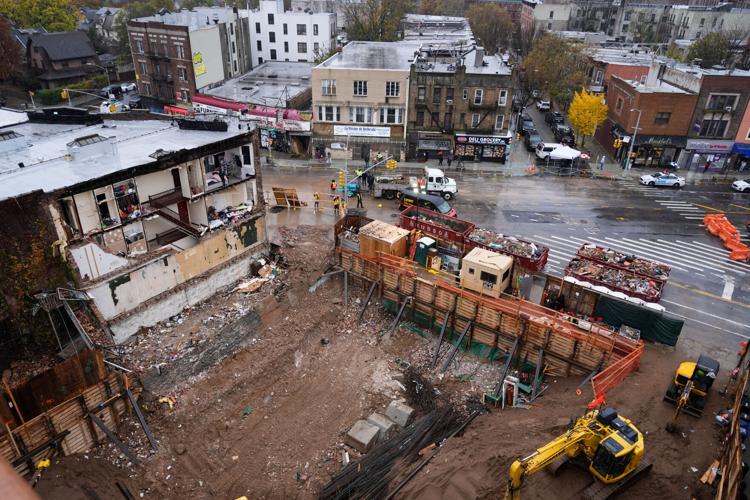
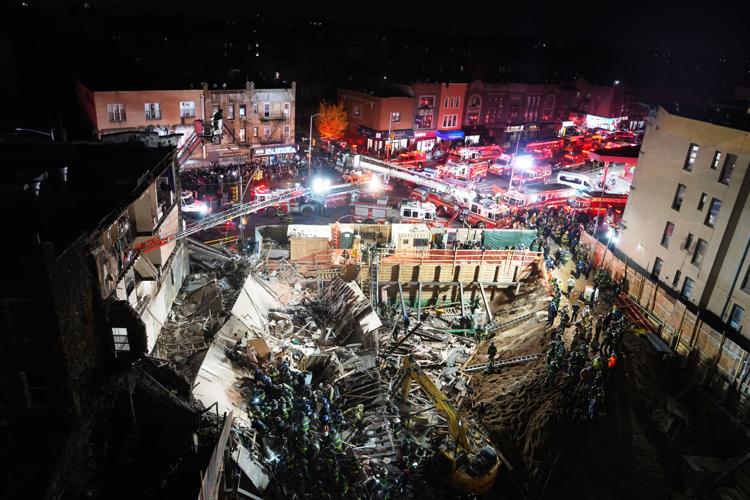
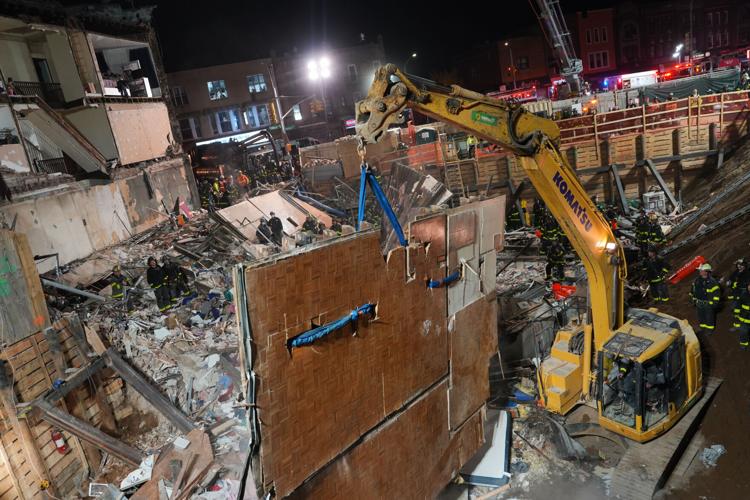
NEW YORK (AP) — As investigators probe what caused a New York City building collapse that killed eight people, workers and residents are painting a portrait of two trouble spots side-by-side: the apartment house that fell down and the construction site being excavated next door.
Lawsuits filed since the Nov. 11 disaster in Brooklyn cast blame in multiple directions: at the construction site owner and contractors; at an engineering firm that drew up the excavation plan; and at the owner of the building that collapsed. Several injured workers have also taken steps toward suing the city agency that polices construction safety.
A key question for investigators is whether work underway to dig a deep pit for a new building undermined the foundation of the three-story building next door at 1321 Flatbush Ave., causing it to topple into the jobsite.
A lawsuit filed by five injured construction workers said the dig at 2625 Bedford Ave. lacked adequate retaining walls, shoring and underpinning to keep the adjoining building safe, and that excavation work continued even after the building's facade began to crack.
“The shoring that they were planning to keep the collapsed building up was severely insufficient,” said lawyer Jonathan Damashek, who has sued on behalf of injured workers. He questioned whether the city should have approved the plans, and whether contractors' work was negligent.
Damashek’s lawsuits accuse defendants, including construction manager Townhouse Homes, of failing “to consider public safety above their own concern of keeping down costs.”
The litigation comes as families mourn the dead — among them two children. City officials said Wednesday that another building adjoining the one that crumbled will have to be demolished after the collapse peeled off an outer wall.
Tenant says construction work next door led to cracks
Buildings Commissioner Ahmed Tigani vowed to do “everything we can to understand exactly how this collapse occurred, so that the responsible parties can be held to account.” His department is hiring an independent engineering consultant to help. Brooklyn prosecutors also are investigating.
The Buildings Department said by email Friday that it reviewed the excavation and support plans and found they complied with city requirements. As for examining what actually got installed, the agency noted that the city requires private inspectors — hired by developers — to check some stages of construction.
The agency didn't answer a question about whether it responded to a preconstruction survey that found the adjoining wall of the now-collapsed building “in poor condition with noticeable cracks.”
That three-story brick structure, erected nearly a century ago, had its own woes — over 90 unresolved citations for exposed wiring, roof leaks, faulty doors and other alleged housing code violations.
Conditions worsened once construction ramped up next door, tenant Dengane Omari Jack said in a lawsuit.
Jack, who lost his extensive record collection and other personal effects, said he was rebuffed when he tried warning the landlord about cracks he noticed near the building’s entrance. After providing photos of the damage, Jack was told it wasn’t the landlord’s fault and couldn’t be fixed, the lawsuit said.
Builder and excavation engineer have faced lawsuits
While the investigation proceeds, the city is checking out over 160 construction sites tied to companies involved in the project at 2625 Bedford Ave., a planned apartment and commercial building.
Townhouse, which also operates as Promont, has been heavily involved in New York’s construction scene over the last three decades.
In 2016, it was accused in lawsuits of damaging an adjacent building during a Manhattan renovation project, which it denied, and compromising the structural integrity of adjacent structures while performing excavation, pile driving and steel beam installation for a Brooklyn hotel. The company's lawyers haven't addressed the allegations in the lawsuit involving the hotel.
Principals in Townhouse, other firms named in this report and the property owners haven’t responded to The Associated Press’ requests for comment.
The Bedford Avenue project’s excavation engineer, Jieming Wang, has also faced lawsuits. At least a dozen have blamed excavation plans designed by his firm, New Jersey-based LMW Engineering Group, for damage at adjacent properties, court records show.
A 2015 lawsuit alleged that LMW’s work on a Manhattan excavation site caused sloping floors, damaged doors and windows and destroyed utility pipes at an adjacent building.
In 2016, the wall of a building next to a Queens excavation project was undermined by soil removal, another lawsuit said. A 2020 lawsuit accused the firm of skipping required testing and monitoring at another Queens project. A neighboring building’s foundation was left unstable, its gas and hot water systems were damaged and an architectural arch partially separated from the structure, the lawsuit said.
The company, which has worked on bridges, airports and other projects since its 1998 founding, denied the allegations in the 2015 and 2016 cases but hasn't responded to the 2020 lawsuit. Other litigation was resolved out of court.
City fined project during demolition phase
The Bedford Avenue project ran afoul of the Buildings Department in March for starting to demolish an existing structure without installing enough netting and other protections from flying debris.
Demolition contractor N Tech Design of America was ordered to stop the work — but continued, got caught again in April, admitted both violations and paid a total of $12,500 in fines, city records show.
N Tech representative Aramis Brown told local news outlet The City Reporter that the company finished its work at the site in May and had nothing to do with the excavation or the collapse.
The excavation work started, with city permission, in September.
Collapsed building owner was on “worst landlords” list
The owner of the building that collapsed, Olufemi Falade, has held a slate of Brooklyn buildings under various corporate names — and has been listed on the city public advocate's “100 worst landlords” roster six times in the last decade.
Falade, a licensed professional engineer, was jailed for 12 days in 2006 for failing to fix violations in a dozen buildings. Then-Housing Commissioner Shaun Donovan called him “one of the most egregious examples we’ve seen citywide of flouting the law and forcing his residents to live in horrible conditions.”
Falade told the Village Voice after his release that tenants weren't paying rent. “People want something for nothing,” he fumed.
He hasn't responded to the AP's requests for comment since the collapse.
At a vigil near the collapse site on Wednesday, housing activists, faith leaders and others called for Falade and the developers to be held accountable.
“New housing cannot come at the expense of tenants’ lives,” said Judith Douglas, a tenant advocate who lives in Flatbush.