NASA Voyager
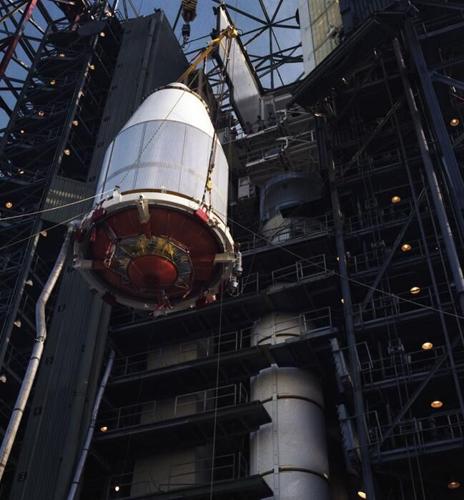
In this image provided by NASA/JPL-Caltech/KSC, The Voyager 2 spacecraft, encapsulated within its payload fairing, is seen in August 1977, as it was being hoisted upward for attachment to its launch vehicle at NASA's Kennedy Space Center in Cape Canaveral, Florida.
As featured on

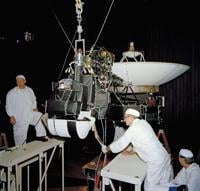
NASA's Voyager 1 is about to become humanity's first object to reach one light-day from Earth. That's a mind-blowing distance of more than 16 billion miles. The spacecraft will reach the extraordinary milestone on Wednesday. At that point, its radio signals will take precisely 24 hours traveling at the speed of light to reach Earth. Its twin Voyager 2 is expected to reach one light-day in 2035. Launched in 1977, the Voyagers have been pushing ever deeper into interstellar space after visiting the outer planets and exiting the solar system.