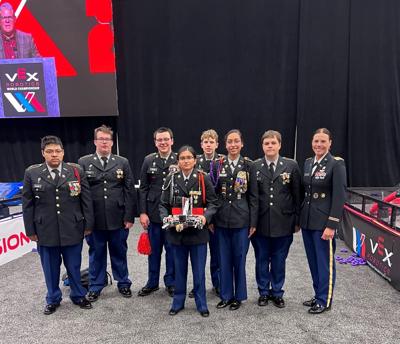
A team of seven students representing Reno High School’s JROTC program ranks in the top 16 teams in the JROTC category at Worlds Robotics Championships in Dallas, Texas.
The competition was held at the Dallas Convention Center, where the Huskies competed against 80 other JROTC teams. At one point in the competition, the Huskies were in second place before they were eliminated in the quarter finals.
This is just the second year Reno High School’s JROTC cadets have had a robotics team, and the second time the team has been entered in the world competition where more than 40 countries showcase their skills in robotics.
“An unbelievable amount of practice and passion and hard work went into the goal of getting to compete at this level, and I am beyond proud of our team,” said Nicole Sarafolean, a JROTC instructor at Reno High School who oversees the Robotics Team. “This is only the second year the Reno High School JROTC program has had a robotics team, and they found their way to the world competition!”
“Military Sciences provides so many opportunities for students in high school and it is wonderful to see our students excel in one of the most recent of those opportunities—robotics!” said Reno High School Principal Kris Hackbusch. “I am very proud of our students.”
The students on the Reno High School team are Kevin Valencia, Zachary Foster, Reeve Lester, Jazmin Tucker, Joshua Krum, Iliana Meneses, and Spencer Klupfell. Team Captain Leo Ketcham was unable to attend the competition, so next year’s team captain Jazmin Tucker led the team to its highest scores ever in Dallas.
In the competition, students built, coded, and manipulated their own technological designs and created their own robots. All the robots had to meet certain criteria to compete, and all robots had to be checked in and inspected prior to the kickoff of the three-day competition.
At the high school level, the students competed in the VEX V5 series of robots.
During a match, the robots had 15 seconds of autonomous time on the field to accomplish missions and tasks.
After the 15 seconds of autonomous time, students took control of their robots to participate in a driver-controlled game for 90 seconds, competing with other students and robots and scoring points by accomplishing certain tasks. Students adapted the designs of their robots between matches, and their work evolved as students learns to identify problems, work within time and resource constraints, and solve problems. Students spent months coding and designing the robot to be able to complete its tasks.