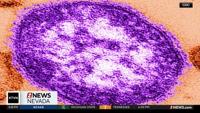

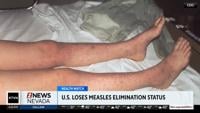
Tuesday morning, the U.S. lost its measles elimination status from the Pan American Health Organization following confirmed cases in 45 states, totaling more than 5,400 confirmed cases nationwide in 2026 alone.
Nevada’s Office of State Epidemiology reports zero confirmed cases this year in the Silver State, and only two confirmed cases in 2025.
One case was in Clark County, and the other was in Washoe County.
It's important to note that a traveler from out of state entered Clark County for a conference in March of 2026 while infectious, but there is no documentation showing anyone else contracted the disease.
These statistics do not mean Nevada has no reason to worry.
“Many of us physicians have actually not seen measles because it was previously eradicated,” said Dr. Kris Wilson, the Division Chief of Pediatrics at Renown Health. “To Nevada in general, the concern now is severalfold. I mean, we live in a commuter state. We have lots of people who come here for commerce, for recreation, both in Reno and Las Vegas, which means that we could theoretically be a hub for measles fairly quickly due to this.”
There are four other states without cases so far this year: Arkansas, Hawaii, Mississippi, and New Hampshire.
The states with the most cases are Pennsylvania, with more than 1,000 cases, which accounts for roughly 28 percent of cases nationwide, and South Carolina with nearly 700 cases.
Symptoms mirror those of the flu, plus the signature rash that breaks out across the face and body. Those vaccinated face only a 7 percent risk of contracting the disease, and their symptoms are generally mild.
The virus is highly contagious, and anyone unvaccinated is estimated to have a 90 percent likelihood of catching it if exposed.
“Measles spreads through respiratory droplets,” said Dr. Wilson. “So, what that means is if somebody sneezes or they cough, they clear their throat or blow their nose, then that respiratory-like particulate containing measles can actually hang in the air for two hours and infect people behind that patient.”
So, what is Nevada doing differently than most of the nation to prevent cases? Truthfully, not much.
The Silver State requires two doses of the MMR vaccine, or the measles, mumps, and rubella vaccine, before children can start kindergarten. Exemptions are allowed for medical or religious reasons. This is why there is roughly 91 percent coverage of Nevada’s school-aged children.
All states except Wyoming also require this -- and Nevada's rate is lower than both Pennsylvania's rate of 92 percent and South Carolina's 93 percent rate of children vaccinated. Wyoming allows for one dose before and another after beginning school.
The U.S. gained the elimination status in 2000. The status is lost when the same measles strain spreads continuously for more than one year.
Sources for the information above include the following links:
Nevada Communicable Disease Reporting | Nevada Public Health
Status of Childhood Immunization in Nevada | International Vaccine Access Center
Additional information was submitted by Northern Nevada Public Health and Renown Health.