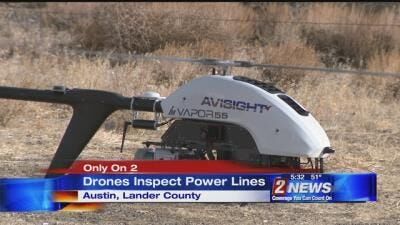
NV Energy is working with the Nevada Institute of Autonomous System and AviSight to use Unmanned Aircraft Systems for utility infrastructure inspections. Drones fly above power lines and inspect them for any kind of problems like clearance, terrain and vegetation under the lines, nearby structures, and the shape of the poles.
"With weather and what not, the poles get wet and they start to semi-lean and that changes the line sag," Chris Hofmann, Director of Electric Delivery in Rural Districts for NV Energy said.
The drone uses LiDAR, a surveying technology that uses lasers to measure distances. The data is collected in near real-time, and creates a 3-dimensional computer model.
"That data will then be integrated into our systems to check for potential issues as well as improving reliability out in the Austin, Nevada area," Hofmann said.
The drones can also detect equipment issues that create heat.
"When the insulating factors of the insulators themselves start to break down, they create a corona signature around it that we can see, and we know there is an issue out there, so we get out there and fix it," Hofmann said.
Hofmann says crews currently do manual inspections of power lines, visually, and with measuring equipment. While the drone can cover two to four miles of power lines in a matter of minutes, he says it would take about a week to do it manually.
"We do have a survey team that actually comes out and does this manually from the ground and then we send them out to each site, pole to pole to pole to pole," Hofmann said.
Nevada is one of seven test sites in the country. The Federal Aviation Administration made that designation in 2016. Since then, NV Energy has done three test flights. AviSight is the company that flies the drones.
"We're a small company," Kevin Fallico, Vice President of Operations for AviSight said. "Something goes wrong with this and it could be the end. So we take every precaution."
The goal is to inspect 41 miles of power lines in central Nevada. NV Energy is working with the FAA to get a Part 107 waiver from the FAA, which would allow pilots to fly drones outside their line of sight.
"When the regulatory environment and the technology marries itself together, maybe one day we'll be doing this mission from my living room," Fallico said.
Fallico says drones could fly for very long distances as long as they have satellite communications. He says once the testing and regulations are in place, UAS technology could be a major piece of technology in the future.
"As the technology grows and they become more prevalent and the costs come down, it's endless," Fallico said. "It's gonna be mapping and survey and it's gonna change the industry, many industries."
NV Energy hopes to have its FAA Part 107 waiver in 2018 or 2019.