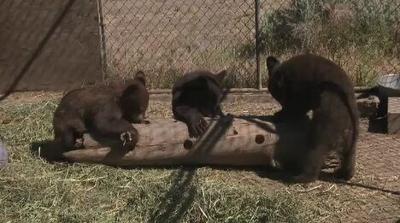

It has been nearly three months since the Animal Ark took on a very unusual challenge, when they took on the task of preparing four bear cubs to go back into the wild. They arrived on April 12, shortly after their 18-year-old mother died. The cubs weighed around seven or eight pounds apiece. Since then, their appetites and their sizes have grown. Their weight has more than tripled, and the largest cub is estimated to weigh 30 pounds.
"It's like working with a barrel of monkeys," Diana Hiibel, Programs Manager & Co-Founder of Animal Ark said. "They are just super active, which helps me to know that they're doing well, that they've got good health."
The cubs are nearly six-months old, and Hiibel says they are off to a good start. They are kept in an enclosure that is out of sight from the public. Only two or three people are allowed to have contact with the cubs. It is important to keep them from getting too comfortable with humans.
"The contact is reduced because of the contact we don't want them to have with humans," Hiibel said. "If they know just a couple of people and there's a little bit of basic trust, that's okay. We don't interact. We don't talk when we're in the enclosure."
Hiibel says rehabbing the bears takes a lot of resources, including maintaining their living space. The four bears eat twice per day, combining to consume 14-16 pounds per meal.
"It's mostly produce but they're also getting some seeds and some nuts," Hiibel said. "We give them quail, actually. So, that would help them with a little bit of natural food."
Local stores and restaurants also donate items, including fish heads and leftovers. While they live in an enclosed area, the cubs get exposure to the wilderness in a simulated environment. They learn to find their own food, which is hidden in logs.
"They're eating insects, which would be normal for them in the wild and we also provide super worms and meal worms, in addition to some pine nuts, dandelions," Hiibel said.
Taking care of the cubs is expensive. Hiibel says the food will cost about $100 per bear, per week when fall arrives.
"It takes a lot and I can't imagine what's going to happen when we hit the first of August when bears, all of a sudden, kick in and it's like 'Oh, I've really got to eat. Winter's coming. We've got to get ready for this,'" Hiibel said.
Once late fall or early winter comes, the Nevada Department of Wildlife will put the cubs into hibernation and move them into a den in the mountains. The idea is for them to wake up in the spring as wild bears. The Animal Ark has successfully done this type of rehab on 30 bears since 1989, but it rarely has more than one or two cubs at a time. As the young bears continue to grow, they will need more living space. The Animal Ark plans on expanding their enclosure in the coming weeks.
Hiibel says they are trying to increase funding for the cubs, and any future bears that arrive, by creating a savings account. To donate online, head to animalark.org or call them at (775) 970-3111. Donations can also be delivered, in person, at the Animal Ark.