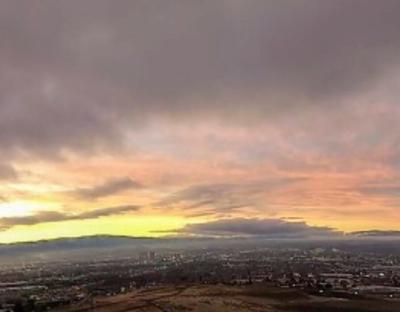
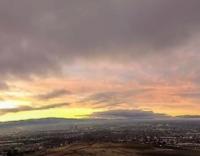
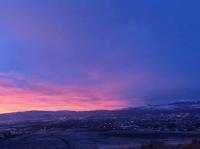
Perhaps you could say the world would be a lot less colorful without sunrises and sunsets. Clouds act like a blank canvas and if they are located in the right spot they can make the colors even more vibrant. We’ve had a lot of pretty sunrises in Northern Nevada lately. Clouds can add to the vibrancy if they are located high enough in the atmosphere. Low level clouds can make the colors a little more blurry. Haze can make a bright red look pink. This is very common in our area. Mid and high level clouds can make the picture even prettier. High cirrus clouds can act as a prism too. Clean air scatters light better than dirty air. A good place to look at sunsets and sunrises is from a plane. The sunset usually gets better with height where the air is cleaner. The photo below as well as the one above, was taken from the National Weather Service in Reno.

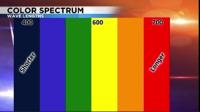
So how does this work? It all has to do with scattering of different wave lengths. Violet and blues being the shortest to red’s having the longest wave length. During the day the sun is directly overhead and the sunlight has a shorter distance to travel. This allows violets to be easily scattered, but since our eyes are more sensitive to blue, we see blue instead. In the evening the light has a longer path to take, leaving red and yellows to shine through.

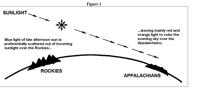
You can see how this works by filling a clear tub with water and a little bit of milk. The milk represents the air particles that the light has to travel through. When you shine a flashlight right up to the tub of liquid the color is blue, but if you shine it at an angle with a longer distance it looks more yellow or red. The photo below is from the Storm Prediction Center and can be found in Stephen Corfidi's paper "The Colors of Sunset and Twilight."