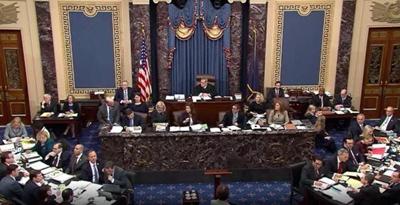

The Senate rejected a motion to allow consideration of additional witnesses and documents in President Trump's impeachment trial, rebuffing Democrats and virtually ensuring the president's ultimate acquittal on charges of abuse of power and obstruction of Congress.
The motion failed by a vote of 49 to 51 on Friday, the 10th day of proceedings against the president in the upper chamber. Democrats failed to convince four Republicans to join them in voting to allow new evidence, with just two GOP lawmakers — Susan Collins and Mitt Romney — crossing the aisle.
Senators Catherine Cortez Masto and Jacky Rosen both voted yes in favor of calling witnesses.
The timeline for the trial going forward remains unclear. The Senate stood in recess after the vote. Democrats could deploy procedural hurdles delaying a final vote into next week.
On Friday, Republicans and the president's legal team argued the introduction of new witnesses and documents would prolong the trial for weeks or months.
They also warned the move would set a precedent of the Senate conducting its own impeachment investigation, arguing the House should have exhausted its options to compel testimony before impeaching the president. Some Republicans conceded the president acted improperly by pressuring Ukraine, but said removing him from office would lead to more frequent and more partisan impeachment proceedings.
"If this shallow, hurried and wholly partisan impeachment were to succeed, it would rip the country apart, pouring gasoline on the fire of cultural divisions that already exist," said Republican Senator Lamar Alexander, who Democrats had hoped would join them. "It would create the weapon of perpetual impeachment to be used against future presidents whenever the House of Representatives is of a different political party."
The House managers, however, warned that failing to pursue new testimony from officials like former national security adviser John Bolton would set a "very dangerous and long-lasting precedent" that would "nullify" Congress' impeachment power.
CNN reports Majority Leader Mitch McConnell proposed a resolution for the next steps in the impeachment trial. You can read the resolution here.
undefined

ORIGINAL STORY:
President Trump's impeachment trial has lurched into a final day of questions and answers before a crucial vote on calling witnesses.
Senate Majority Leader Mitch McConnell opened Thursday's session bracing for an attempt by Sen. Rand Paul of Kentucky to expose the name of the still anonymous whistleblower in the public trial.
McConnell urged restraint by his colleagues.
But to no avail.
Paul quickly rose to put forward one of the first questions of the day, drawing a long pause in the chamber as Chief Justice John Roberts looked over the submission.
Said Roberts: “The presiding officer declines to read the question as submitted.”
The chief justice, who plays the rare role of fielding questions during the impeachment trial, had communicated through his staff to McConnell’s office that he did not want to read the whistleblower's name, according to a Republican unauthorized to discuss the private conversation and granted anonymity.
Senators on Wednesday asked nearly 100 questions before adjourning for the night.
In brief remarks, McConnell thanked senators for being respectful of Roberts' position in reading their questions and said he wanted to "be able to continue to assure him that the level of consideration" will continue.
The question of whether to allow consideration of new witnesses and documents will come to a head on Friday.
If Democrats fail to convince at least four Republicans to join them in calling for witnesses, the Senate could move quickly to a final vote on acquittal.
But if enough Republicans side with Democrats, the trial would stretch into next week and possibly longer, with contentious battles over individual witnesses on the horizon.
In the meantime, attention is focusing on a Trump attorney's controversial defense and a Republican senator's effort to expose the whistleblower who started the impeachment probe.
Retired professor Alan Dershowitz is now saying his sweeping argument against conviction in the trial was misunderstood.
Even some of Trump's Republican supporters have been backing away from the argument _ basically that a president cannot be impeached for actions that would help him win rerelection if he believes his reelection would be in the public interest.
Dershowitz says that's not what he meant and not what he said.
During questioning on Wednesday, Dershowitz said: “If a president does something which he believes will help him get elected, in the public interest, that cannot be the kind of quid pro quo that results in impeachment."
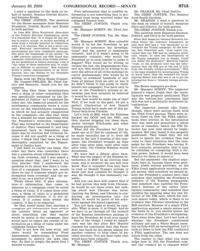
On Thursday, Senator Jacky Rosen asked a question pertaining to the president's actions while Senator Catherine Cortez Masto asked about President Trump's due process on Wednesday night. (Both senators' comments are below)


undefined