
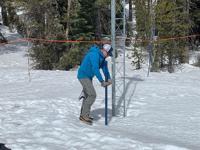
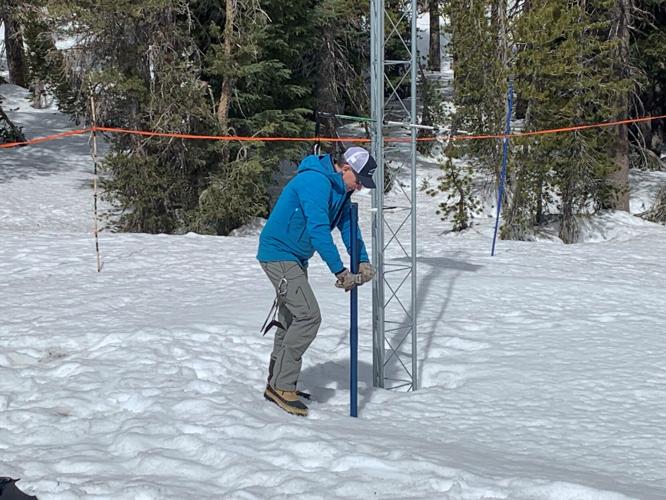
The final snowpack survey of the year ended with underwhelming numbers. The April 1 measurements had the Truckee Basin at 60 percent, Lake Tahoe Basin at 55 percent and the Carson Basin at 51 percent. Those basins all peaked on March 1 at 70 percent of the median.
"It's a little disappointing, standing here after we got off to such a strong start," Bill Hauck, Water Supply Supervisor for the Truckee Meadows Water Authority said.
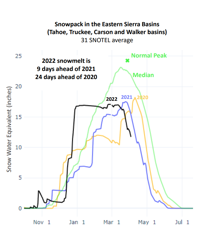
The low snow totals come after heavy rainfall in October and record snowfall in December gave the region a head-start on its snowpack. On January 1, the snow measurements were almost 200 percent of normal. Unfortunately, the storms stopped coming after that. January, February and March had the lowest snow totals on record for those three months. SNOTEL sites usually get 10-30 inches of snow during that period. This year, they only received 1-4 inches.
"When you add that on top of a record-breaking October and then some of our snowfall totals we've ever seen in December, it's really kind of crazy," Jeff Anderson, Hydrologist for the Natural Resources Conservation Service said.
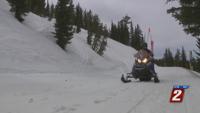
55 inches of snow remain at the Mt. Rose SNOTEL site. The water content is 24.2 inches. Snow levels usually peak in mid-April. The higher temperatures caused the snow to start melting about one month earlier than usual.
"The fact that we've seen four inches of melt, you know, really helps us to know the snowpack is melting quicker than it has in past years, including the last two years," Anderson said. "In late March, when we had the 80 degree temperatures down in the valley, snowmelt was really rapidly progressing at our SNOTEL sites."

Truckee River flows are already picking up because of the water runoff.
"As little snowpack as we have, we still have a pretty decent amount of water in storage in the upstream reservoirs, and that means that we're going to have basically normal Truckee River flows through the summer months and past our peak demand season," Hauck said.
Despite the early melt and the below-average snowpack, residential use is not expected to be an issue. Like every year, customers are asked to water their lawns and plants, responsibly.
"We're going to ask customers to continue watering on their assigned days and when the summer starts, watering during the recommended hours," Hauck said.
TMWA plans for water supply, many years into the future. Hauck says drought reserves are in great shape. The Truckee River Operating Agreement allows TMWA to store more water than it could in years past.
"By the middle of summer, we'll actually have more water in storage in reservoirs than we've ever had at any point in time," Hauck said.
Farmers could feel the impact more than anyone. Lake Lahontan is not expected to get very high, so the Truckee-Carson Irrigation District established a 70 percent allocation for Fallon farmers and 90 percent for Fernley farmers. The TCID is meeting to decide whether to reduce allocations even more. The Lovelock area is in much worse shape. Rye Patch Reservoir is so low, there is not enough water to turn on the irrigation system. That means farmers in that area might not have any water for their crops. The Walker River Irrigation District forecasts Topaz allocations at 34 percent and Bridgeport at 26 percent.
"I think most of those irrigation companies are looking at less than a full allocation for this year," Anderson said.
A third straight year of below-average snowpack could also have an impact on forests. Since the snow is melting earlier, it could extend fire season.
"The forest is going to have a longer period of time to dry out, this summer, so I think that should be a concern for us," Anderson said.
Lake Tahoe is about one foot above its natural rim. Hauck says that might rise a few more inches during the spring runoff.