








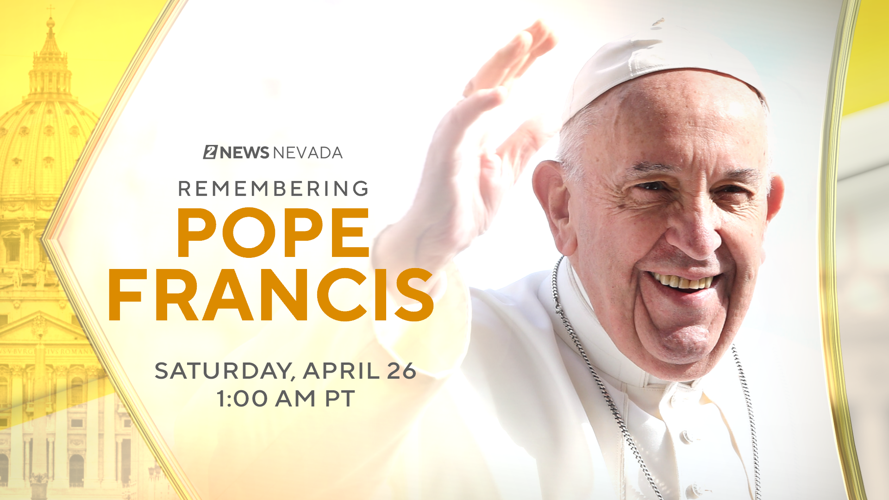
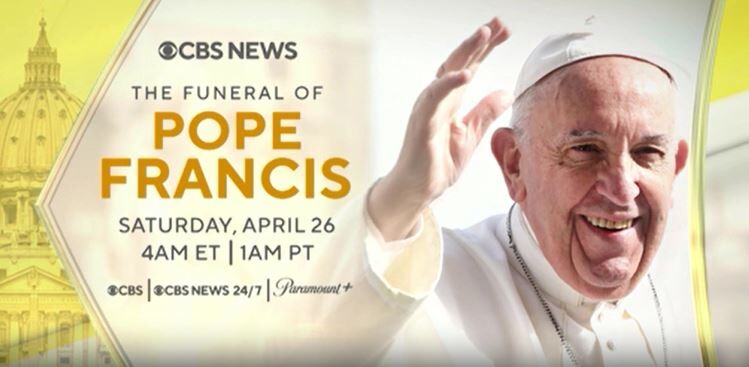

Three days of public viewing of Pope Francis' body by ordinary mourners and statesmen alike ended Friday. Francis died on Monday at age 88 after suffering a stroke.
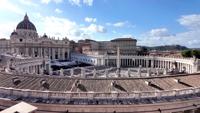
The Vatican said that around 250,000 mourners filed through St. Peter’s Basilica over the three days to pay their last respects as Francis lay in state in a simple wooden coffin.
Hundreds of disappointed people were turned away when authorities closed St. Peter’s Square hours before the viewing period ended.
The pope’s casket will be closed and sealed later Friday in the next in a series of carefully orchestrated rites set off by the death of a pope. Francis will be buried after a funeral Mass on Saturday, which will be attended by heads of states, royals, prelates and ordinary mourners.
Pope Francis chose his place of burial in St. Mary Major Basilica, near an icon of the Madonna that he revered, because it reflects his “humble, simple and essential’’ life, the archbishop who administers the basilica told reporters on Friday.
Francis, who died Monday at age 88, will be buried in a niche tomb in the basilica on Saturday after his funeral in St. Peter's Square about 4 kilometers (2½ miles) away.
Francis initially demurred when Archbishop Rolandas Makrickas suggested in May 2022 that he choose St. Mary Major as his last resting place. Makrickas had identified it because of Francis' long association with the basilica, its ties to Francis’ Jesuit order, its artistic and spiritual heritage and links to the papacy. Seven other popes are buried there, but none since 1669.
At first, "he said no because popes are buried in St. Peter's," Makrickas told reporters on the steps of the basilica. “After a week, he called me to (his home at the Vatican) Santa Marta and he said ‘Prepare my tomb.’"
The pope later insisted that his tomb remain simple, insisting that people should still come to the basilica dedicated to the Virgin Mary “to venerate the Madonna, not to see the tomb of a pope," Makrickas said.
Francis will be buried beneath a simple headstone made of marble from Liguria, the Italian region of his mother's family, engraved with his name in Latin: Franciscus. Above it will hang a slightly enlarged replica of his pectoral cross, featuring raised images of a shepherd carrying a sheep over his shoulders and a dove, but no other adornments.
The tomb is placed in a niche next to the chapel where the Salus Populi Romani icon that the pope revered is located, and in a part of the basilica that was once a door to an adjacent palace where four popes lived. During his 12-year papacy, Francis would pray before the icon before and after each foreign trip.
The basilica also has significance for the Jesuit pope: It's where the founder of the religious order, St. Ignatius Loyola, celebrated his first Mass on Christmas Day in 1538.
The basilica is a pontifical basilica, one of four in Rome, and has never been “destroyed, damaged or burned” over the ages, with history dating back to the fifth century. Makrickas called it “a treasure chest of art and spirituality."
Nevadans React:
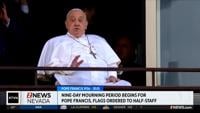
At the direction of President Trump, Nevada Governor Joe Lombardo has ordered the flags of the United States and State of Nevada to be lowered to half-staff immediately to honor the memory of His Holiness Pope Francis.
The flags will remain at half-staff until sunset on the day of interment.
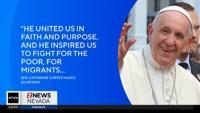
While several state lawmakers released statements after his death, southern Nevadans are also remembering Pope Francis for creating the first Archdiocese in the state, in Las Vegas in May 2023.
The Archdiocese of Las Vegas covers 39,088 square miles in Nevada, and is comprised of 750,000 Catholics.

The Argentine pope died Monday at age 88 after a stroke put him in a coma and led his heart to fail. He had been recovering in his apartment after being hospitalized for five weeks with pneumonia. He made his last public appearance Sunday, delivering an Easter blessing and greeting followers from his popemobile, looping around St. Peter's Square.
His Easter appearance from the same loggia where he was introduced to the world as the first pope from the Americas on March 13, 2013, was a fitting bookend to a 12-year papacy that sought to shake up the church and return it to its Gospel-mandated mission of caring for the poorest.
Vatican officials remember Francis
“He truly gave everything he had, up to the end,” said Sister Nathalie Becquart, one of the highest-ranking women at the Vatican.
While the ordinary faithful will have an opportunity to pay their respects beginning Wednesday, Vatican officials were allowed to say their goodbyes starting Monday evening. Speaking to reporters after she paid her respects, Becquart marveled at Francis' final Easter salute to his flock. “He really walked with his people,” she said.
Italian Cardinal Gianfranco Ravasi said it was specifically Francis' effort to promote the role of women in the church that will be one of his greatest legacies. Ravasi noted that Francis chose to be buried near his favorite icon of the Madonna, in a basilica across town, and not in the grottoes underneath St. Peter's, as is typical for popes.
“He wanted to be buried under the shadow of a woman, in this case Maria,” said Ravasi, the Vatican's former culture minister as he arrived for Tuesday's first meeting of cardinals. “That is significant, his desire for the church to do more for women.”
The first images of Francis' body were released Tuesday, showing him in red vestments and his bishop’s miter in a wooden casket, with the Vatican secretary of state praying over him in the chapel of the Domus Santa Marta hotel where he lived and died.
In his final will, Francis said he wanted to be buried at St. Mary Major Basilica, which is home to the Salus Populi Romani icon of Mary. Before and after every foreign trip, Francis would go to the basilica to pray before the Byzantine-style painting that features an image of Mary, draped in a blue robe, holding the infant Jesus, who in turn holds a jeweled golden book.
Francis stopped by the basilica on his way home from the Gemelli hospital on March 23, after his 38-day stay, to deliver flowers to be placed before the icon. He returned April 12 to pray before it one last time.
Choosing the next pope
After the funeral, there are nine days of official mourning, known as the “novendiali.” During this period, cardinals arrive in Rome and meet privately before the conclave.
To give everyone time to assemble, the conclave must begin 15 to 20 days after the “sede vacante” — the “vacant See” — is declared, although it can start sooner if the cardinals agree.
Once the conclave begins, cardinals vote in secret sessions in the Sistine Chapel. After voting sessions, the ballots are burned in a special stove. Black smoke indicates that no pope has been elected, while white smoke indicates that the cardinals have chosen the next head of the Catholic Church.
The one who has secured two-thirds of the votes wins. If he accepts, his election is announced by a cardinal from the loggia of St. Peter's Basilica who tells the world: “Habemus Papam” — Latin for “We have a pope.”