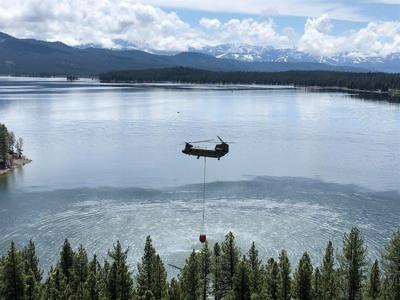
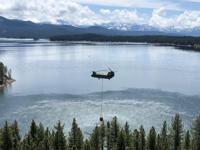
The Nevada Army National Guard has a lot of different missions, including fighting fires. Crews flew a Chinook and Blackhawk helicopter over Stampede Reservoir, Friday, preparing for what could be a busy wildfire season. The Chinook would fill its bucket, then drop it in the nearby forest. The area represented a wildland fire.
"Fires can be very intense," Chief Warrant Officer 4 Steve Nielsen, Pilot in the Nevada Army National Guard said. "Lots of things going, lots of other traffic. You've got flames, the fires, everything like that. So it's always good to get prepared before going to actual fires."
"Fires can happen at any time and so we want to be ready," Capt. Nigel Harrison, Pilot in the Nevada Army National Guard said. "We want to make sure our crews are ready. It's a super dangerous profile that we fly in and we want to make sure our crews are as safe as possible and they know what to do."
Each helicopter typically has a four-man crew. They say with so many different elements involved in fighting fire from the air, they need the extra teamwork.
"You've got two pilots up front and then usually two flight engineers in the back," Nielsen said. "We rely on them heavily because we can't see everything that's going on."
"We have the terrain, we have the trees, there can be wires, everything," Harrison said. "So we need as many eyes outside as possible."
They say they can't take this job lightly. It requires a lot of attention to detail. Nielsen says fighting fires can be more dangerous than most missions, including combat.
"The combat, you're not always getting shot at but fighting fires, you've got a lot of other air traffic, tankers, other helicopters, personnel on the ground, as well as the flames and the smoke," Nielsen said.
Chinooks are built to carry more weight than the Blackhawks. The larger helicopters can carry 2,000 gallons of water at a time, compared to the smaller Blackhawks which can carry 660 gallons.
"They have the capability of dropping a lot more water on the fire but at the same time, they burn a lot more fuel," Harrison said. "There's a balance there."
These pilots say they have to be prepared to fly into a fire at a moment's notice. That's why this training is so important. They know they will likely have to fight real fires, this summer.
"When we get the go-ahead, we can be off the ground in a half-hour, ready to go fight the fires," Nielsen said.
They say the job comes with some stress, but is also enjoyable. Each summer has its own challenges.
"We've had times where we've been out for months," Nielsen said. "Other times, we haven't been called out at all. Sometimes, it's just fore a few days, so it all depends."
"It's stressful but like anything else, as soon as you get your feet underneath you and you figure out how to do things safely and well, it does become fun," Harrison said. "It's a profile that a lot of helicopter pilots don't get to do."
These drills allow pilots to polish up their flying skills, and work on their accuracy. They want to drop the buckets of water on a particular spot, like they would during a real fire.
"We try to be as precise as possible because a lot of times, the firefighting ground crews will call us in and want a specific area that they want us to hit," Nielsen said.
Some of the crew will deploy to Afghanistan, later in the summer. They say Governor Sisolak wants to keep some of them here for domestic emergencies, so they will still have people to fight fires.
"Instead of deploying the entire unit, they broke us up in half," Harrison said. "Some of us are deploying in a couple months and the next half will be replacing us. We'll just swap."
For now, they will continue to do the job when they are called on. They know the risk, but say it's worth it.
"Being able to go out there, not only work with the firefighters on the ground, we also get to save people's property and sometimes save lives," Harrison said. "So it's definitely rewarding."
The Nevada National Guard has six Chinooks and six Blackhawks. Officials say they flew more than 100 hours during the last fire season.