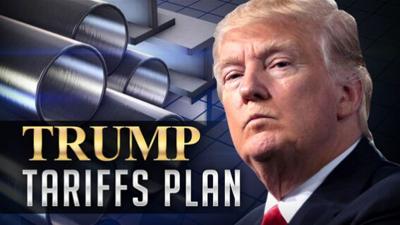
The Trump administration is announcing tariffs on steel and aluminum imports from the European Union, Canada and Mexico. The move is sure to raise worries of a trade war with American allies.
Commerce Secretary Wilbur Ross says there will be a 25% tariff on imported steel and a 10% tariff on imported aluminum.
President Donald Trump announced the tariffs in March but the U.S. granted exemptions to the E.U., Canada, Mexico and other U.S. allies.
Ross says talks with Canada and Mexico over the North American Free Trade Agreement are "taking longer than we had hoped." He says negotiations with Europe have "made some progress" but not enough to merit an exemption.
In a presidential proclamation released Thursday morning, President Trump writes that agreed with Secretary Ross' assessment that "aluminum articles are being imported into the United States in such quantities and under such circumstances as to threaten to impair the national security of the United States."
"I further stated that any country with which we have a security relationship is welcome to discuss with the United States alternative ways to address the threatened impairment of the national security caused by imports from that country, and noted that, should the United States and any such country arrive at a satisfactory alternative means to address the threat to the national security such that I determine that imports from that country no longer threaten to impair the national security, I may remove or modify the restriction on aluminum articles imports from that country and, if necessary, adjust the tariff as it applies to other countries, as the national security interests of the United States require," Trump added.
Mexico says it will answer tariffs on steel and aluminum with duties of its own on a variety of U.S. products.
Mexico says it will impose tariffs on U.S. imports including pork bellies, apples, grapes, cheeses and flat steel among other things.
A statement from Mexico's economy ministry says the U.S. use of a national security justification is improper and that the tariffs affect strategic sectors for North America, including automotive, aerospace and electronics.
Trump announced the tariffs in March, but gave exemptions to the European Union, Mexico and Canada.
Ontario's premier called President Trump a "bully" and says the new U.S. tariffs are "ridiculous and unwarranted."
Kathleen Wynne says Canada has to send a signal to Trump that Canada "will not be your doormat."
She says the only way to stand up to a bully is to stand up and push back. She's urging Canada take a swift and sharp retaliatory response.
Wynne says Trump's actions will hurt jobs in the United States and Canada.
The German government rejected the tariffs as "unlawful."
A spokesman for German Chancellor Angela Merkel refers in a statement to "the danger of spirals of escalations" that could hurt everyone.
The European Union stands ready to retaliate immediately following the new tariff announcement.
European Commission President Jean-Claude Juncker says "it's totally unacceptable that a country is imposing unilateral measures when it comes to world trade."
He says to expect "counterbalancing measures" from Europe soon.
Earlier this week, the U.S. announced that it will impose a 25% tariff on $50 billion worth of Chinese goods containing "industrially significant technology."
The White House said Tuesday that the tariff will cover goods related to the "Made in China 2025" program. The full list of imports that will be covered will be announced by June 15.
Trump has bemoaned the massive U.S. trade deficit with China - $337 billion last year - as evidence that Beijing has been complicit in abusive trading practices.
The White House wrote in its statement on Tuesday that the United States "will continue efforts to protect domestic technology and intellectual property, stop noneconomic transfers of industrially significant technology and intellectual property to China, and enhance access to the Chinese market."
The White House also says the U.S. is planning new investment restrictions and export controls for "Chinese persons and entities related to the acquisition of industrially significant technology" as well as "pursue litigation at the World Trade Organization for violations of the Agreement on Trade-Related Aspects of Intellectual Property Rights based on China's discriminatory practices for licensing intellectual property. "
The announcement comes as the administration negotiates with China on a broad trade dispute. Commerce Secretary Wilbur Ross is expected to travel to China later in the week for more talks. In its announcement on Tuesday, the White House continued to push for trade barriers to come down which they claim "make it both difficult and unfair to do business there."
The statement added, "The United States will request that tariffs and taxes between the two countries be reciprocal in nature and value. Discussions with China will continue on these topics, and the United States looks forward to resolving long-standing structural issues and expanding our exports by eliminating China's severe import restrictions."
(The Associated Press, CBS News contributed to this report.)