

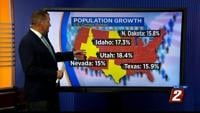

Nevada has the fifth highest population growth rate in the country at 15 percent. Utah has the highest rate at 18.4 percent, followed by Idaho (17.3 percent), Texas ( 15.9 percent) and North Dakota (15.8 percent). Texas had the most new residents with 3,999,944. Nevada is 17th with an increase of 404,063. Most of that growth is in southern Nevada. Clark County grew by 314,192 residents and Washoe County grew by 65,085 residents.
"It's a good increase, reflective, I think of the economic development out in the canyon and the redefinition of our economy in Reno and Sparks but it's not dramatic," Fred Lokken, Professor of Political Science at Truckee Meadows Community College said.
The growth could have impacts down the road. Clark County now makes up nearly 73 percent of the state's population. Two-thirds of the state legislature's seats come from Clark County, dominating the policy-making in Nevada.
"It just becomes more so because they easily earn a couple of more seats in the state assembly, the way that they have to draw the state senate will incorporate much of Clark County," Lokken said.
Gov. Steve Sisolak, D-Nevada, is expected to call a special session in the fall so the legislature can redraw its districts.
Esmeralda, Eureka, Lander, Lincoln, Mineral, Pershing and White Pine Counties all shrank in population. The other 10 counties grew. Nye County had the highest growth rate of 17.4 percent. It's growth of 7,645 was far less than those in the state's two largest counties. That is reflective of the rest of the country, which is seeing more growth in urban than rural areas.
"In the case of Nevada, most of our growth was in two of the 17 counties, the two most urban counties," Lokken said.
Demographically, there was a big shift. The number of white residents dropped by 198,225 from 66.2 percent in 2010 to 51.2 percent in 2020. Every other race saw large increases.
"Part of what's been going on in Nevada over the past several years is that we have an aging population and that's happening more in probably our White Alone population," Jeff Hardcastle, Former Nevada State Demographer said.
Blacks/African Americans make up 9.8 percent of Nevada's population, American Indian/Alaska Native (1.4 percent), Asian (8.8 percent), Native Hawaiian/Pacific Islander (0.8 percent), Other (14 percent), Two or more races (14 percent). The number of people who claim two more more races jumped by 244.2 percent. They made up 4.7 percent of the population in 2010. Hispanics and Latinos make up 28.7 percent of the population. The shift in demographics could have huge implications in future elections.
"As we change demographically, that category has a profound impact on our politics," Lokken said. "The challenge with the Hispanic population has been it's lack of engagement relative to its size."
The census is important for a number of reasons. One of them is the determination of each state's congressional seats.
"We did not gain a seat this time but then it also impacts things like federal funding formulas," Hardcastle said.
Hardcastle expects Nevada to receive more federal funding because of its population growth.