

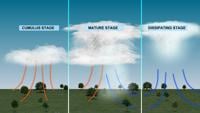
Thunderstorms can be dangerous, but they can also provide us with some much-needed rain. You don’t want to get stuck in one, though.
That is why if you plan on hiking, the morning is usually your best bet. This is not always the case, though.
According to NASA, most thunderstorms over the ocean occur in the early morning hours.
Sometimes thunderstorms can develop overnight and into the morning, but since they feed off of daytime heating, they usually occur in the afternoon.
If you watch a cumulus cloud, you’ll see it grow as the day goes on. Eventually becoming heavy enough to rain.


In places like Mississippi or Alabama, thunderstorms are more common at night because it stays warm and humid. In Nevada, though, they usually fade pretty quickly.
Our thunderstorms are usually short-lived, and as the sun sets, temperatures drop very quickly. The air is very dry in northern Nevada and cools off quickly.
We can get thunderstorms at night in northern Nevada and California, but it does not happen very often.
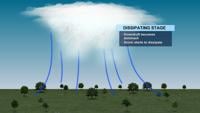
If it does, it’s usually because we have a low moving through at night, and the air is more unstable than it normally is. As evening thunderstorms dissipate, they let out a cool rush of air, stabilizing the atmosphere as well.

Our instability or CAPE Values are usually much lower in Reno than they are in other parts of the country.
In Reno, they are usually less than 1,000 j/kg, whereas it is common for places like Oklahoma to see values exceed 1,000 j/kg on thunderstorm days.


Thunderstorms are ongoing in parts of Nevada Monday afternoon as an area of low pressure moves east.
The storms are firing in Mono, Mineral, Nye, and Esmeralda Counties Monday afternoon with some heavy downpours and lightning.
Gusty winds can’t be ruled out either. The storms will still be going at 10 p.m. in eastern Nevada, but will dissipate overnight. Storm chances move further east on Tuesday as the low moves east well.
