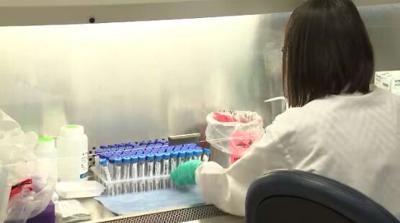

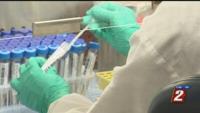


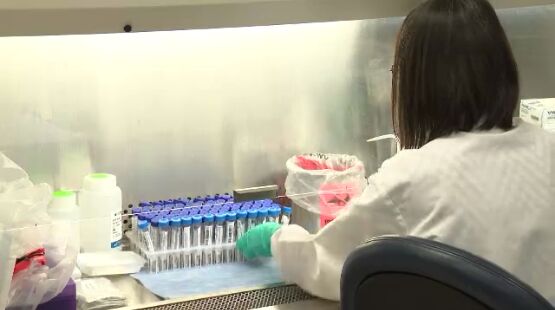
Just a few weeks ago, the Nevada State Public Health Laboratory (NSPHL) had the ability to test about 500 samples for COVID-19. Thanks to some changes to some changes in the chemistry involved in the testing, and because of new technologies, it has more than doubled its capacity.
"We're up to over 1,000 tests a day, and very shortly should be able to do even as many as 2,000-3,000 a day," Dr. Mark Pandori, Director of the NSPHL said.
The state health lab tests people from Washoe County and the rural counties. It even tested some Clark County residents for the new coronavirus, early on. Pandori says since February 11, the lab has tested more than 16,000 samples. He says the testing capacity is very good in relation to the state's population.
"You never want to rest on your laurels," Pandori said. "You don't want to celebrate or do a victory lap and say 'Hey, look at all these tests we've done' because the fact is we could always benefit from doing more."
Pandori says each sample offers valuable intelligence about the virus and the risks. That information could be used to help determine how to reopen Nevada's economy.
"What are we getting ourselves into?" Pandori said. "Because if we're going to ask people to interact or be closer than six feet to one another, we need to know what's the probability that that person next to you might in fact be infected."
Collection kits are used to collect specimen's from people who have symptoms of COVID-19. The University of Nevada School of Medicine is manufacturing the kits by 3D printing swabs. Private businesses are also manufacturing tubes, while FEMA is providing more kits. The kits include a swab, tube and a liquid called a "virus transport media". The liquid is different, depending on the type of collection kit. Some of the liquid makes the process safer.
"We call it a detergent and the detergent in here will actually slay the virus, immediately," Pandori said.
Once the samples go to the lab, the data for each individual is collected. The lab workers then use test kits to analyze the samples. Those are made up of chemicals and equipment. The Panther is a machine that can test more than 100 samples at a time. However, Pandori says testing capacity requires a lot more than just the proper tools.
"You've got to advertise or market that lab testing is available but you have to have people to collect specimens," Pandori said.
Washoe County is only testing people who have symptoms of the disease. Officials say asymptomatic testing has a higher likelihood of false negatives because the individuals might not have enough virus in their system to register. People with symptoms are also more likely to test positive for COVID-19. Once the tests are validated, the health districts use the information to gather more information through contact tracing. That requires them to contact anyone who may have may have been exposed to the people who test positive.
"It's a little bit like a fire. A fire starts and then it spreads," Pandori said. "Firemen don't just go treat the source. Fire people go and they start creating a perimeter around the fire."
Wednesday, Washoe County Health District (WCHD) Officer Kevin Dick announced that it will begin testing people for antibodies for COVID-19. The NSPHL recently finished a validation study of the Abbott Test. The Food and Drug Administration granted an Emergency Use Authorization for its antibody tests. It is one of about a dozen in the U.S. It's performance data shows that out of more than 1,000 samples, only four were false positives. The health lab's study verified that information.
"People that had previously tested positive, tests actually were detected as having antibody and people that had previously tested negative for the swab test, tested negative for the antibody," Pandori said.
The antibody tests could help determine how many people within the population have been infected with COVID-19 and did not know it. They could show that some may have contracted the disease back in January or earlier. That was well before Nevada's first positive case in early March.
"Rarely is it that you get the ability to go back in time," Pandori said. "Rarely...never, but in fact, here with an antibody test, you kind of have that ability."
The WCHD will team up with the University of Nevada, Reno to conduct the antibody tests, randomly.
"If you want to look at a population at-large, that's best done by doing a random sampling," Pandori said.
Many people think they may have already had COVID-19 but did not know it. Pandori says many had symptoms but they could have been the result of other respiratory illnesses like Influenza or the common cold. Since the testing is random, people will not be selected to take the blood test just because they think they might have been infected in the past.
"In medical science and public health science, curiosity is not a great reason to get a lab test," Pandori said. "It's a medical resource and in a time like this, medical resources are precious."
Pandori says there would be some value to testing specific people within the population, like medical workers. Since they are at a higher risk of contracting coronavirus, the testing could provide data on its prevalence in the medical community.
"There was a lot of risk," Pandori said. "What really happened to your population? How many of you really were infected and you didn't know it? Or maybe you just felt a little run down, one day."
It is still too early to know how the antibodies will affect immunity in a person. There are many types of coronaviruses, including the common cold. Many of those show that immunity does not last very long.
"Maybe there would be confidence about certain people going back to work because we know that they were immune," Pandori said. "It's maybe upsetting to the community still but we just don't know that yet."
In addition to antibody testing in June, Dick says there is a plan for another round of testing in the fall and after flu season.