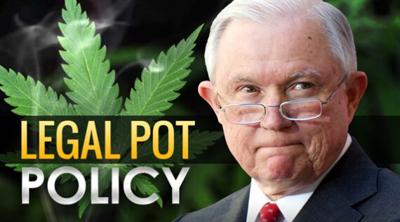



Attorney General Jeff Sessions has rescinded an Obama-era policy that paved the way for legalized marijuana to flourish in states across the country, creating new confusion about enforcement and use just three days after a new legalization law went into effect in California.
President Donald Trump's top law enforcement official announced the change Thursday. Instead of the previous lenient-federal-enforcement policy, Sessions' new stance will instead let federal prosecutors where marijuana is legal decide how aggressively to enforce longstanding federal law prohibiting it.
Sessions rescinded the policy by President Barack Obama's Justice Department that has generally barred federal law enforcement officials from interfering with marijuana sales in states where the drug is legal.
"In deciding which marijuana activities to prosecute under these laws with the Department's finite resources, prosecutors should follow the well-established principles that govern all federal prosecutions," by considering the seriousness of the crime and its impact on the community, Sessions wrote in a one-page memo to the nation's federal prosecutors.
The move by Trump's attorney general likely is sure to add to confusion about whether it's OK to grow, buy or use marijuana in states where the drug is legal.
Sessions' plan drew immediate strong objection from Republican Sen. Cory Gardner of Colorado, one of eight states that have legalized marijuana for recreational use.
Gardner said in a tweet that the Justice Department "has trampled on the will of the voters" in Colorado and other states. He said the action would contradict what Sessions had told him before the attorney general was confirmed and that he was prepared "to take all steps necessary" to fight the step including holding up the confirmation of Justice Department nominees..
So far eight states (including Nevada) and the District of Columbia have legalized the drug for recreational use, and it is now helping to fund schools and even law enforcement.
U.S. Sen. Dean Heller says Justice Department officials should meet with Gov. Brian Sandoval and state Attorney General Adam Laxalt about how the policy change might affect Nevada.
We spoke with local marijuana industry expert, Will Adler, the Director of the Sierra Cannabis Coalition, to see how this might affect legal pot in the Silver State.
Adler says the Cole Memo was more of a federal guideline that will likely not make or break marijuana sales in Nevada. He says, "The reality is Nevada has far better laws than the Cole Memo dictates anyway. We're more detailed, we're more precisioned, and we really have the gold standard for marijuana laws across the country."
Adler also says that there would also have to be a lengthy process to see federal action against legal weed in Nevada, in part due to government funds. He explains, "Every time you have a budget renewal, there's actually an amendment, the Rohrabacher-Farr amendment, that says there is no funding for the Department of Justice to come in and enforce state level medical marijuana operations."
Meanwhile, the CEO of local dispensary Sierra Well, Fernando Leal, says he thinks the announcement will actually generate a net positive in the long run. Leal says, "I don't think that this issue and this ruling is necessarily about cannabis, it's about protecting states' rights and our state voted 56 percent to legalize marijuana."
He says that working in an industry that is not legal on the federal level has proved difficult, with issues like banking. With the dialogue created by this move from AG Sessions, Leal believes it will create a much-needed discussion to clarify any gray areas within the industry. Leal hopes it will eventually lead the way to a clearer, more well-regulated, legal industry.
However, not everyone is on board with keeping weed legal. For example, former Congressman and current honorary advisory to Smart Approaches to Marijuana, Patrick J. Kennedy, said in a statement, "The Cole Memo had been waived around by money-hungry pot executives for years...It's time we put public health over profits."
Governor Sandoval released this statement:
“Since Nevada voters approved the legalization of recreational marijuana in 2016, I have called for a well-regulated, restricted and respected industry. My administration has worked to ensure these priorities are met while implementing the will of the voters and remaining within the guidelines of both the Cole and Wilkinson federal memos. We have been largely successful in these efforts. I believe Nevada’s marijuana industry is a model for other states. My staff and I will review the memo released this morning and our state options. I look forward to the appointment of the new Nevada United States Attorney and further guidance that will be provided by the Department of Justice.”
Laxalt's office says it is also reviewing the DOJ’s letter on the withdrawal of the Cole Memorandum, and evaluating the ramifications for the state of Nevada.
Many other Nevada lawmakers released statements in response to Thursday's announcement. They are listed below the memos -
Nevada Attorney General Adam Paul Laxalt issued the following statement:
“Although I opposed the Question 2 ballot initiative proposing the legalization of recreational marijuana in Nevada, I also pledged to defend the measure were it approved by the voters. Since Questions 2’s enactment, my office has vigorously defended it against two related lawsuits that threatened to slow or even halt the implementation of the law, and has further assisted with the formulation and adoption of regulations to allow dispensaries to commence sales of recreational marijuana within just six months of the law’s enactment. My office has expeditiously facilitated the implementation of the law in the face of considerable uncertainty about the status of federal enforcement activity.”
U.S. Senator Catherine Cortez Masto released this statement:
“Attorney General Sessions says he is a headstrong advocate for states’ rights. However, his decision giving free rein to federal prosecutors to target the cannabis industry in states where voters and legislatures have chosen to legalize and regulate the use of marijuana exposes his hypocrisy. In states like Nevada, voters have spoken loud and clear that marijuana must be regulated and taxed, and that the state should be able to enforce its marijuana laws without federal interference. By rescinding the Cole memo, this administration is trampling on the will of Nevadans and creating unnecessary confusion for our state. I call on the Attorney General to reinstate the memo and work with Congress to ensure we respect the will of states while ensuring prosecutorial resources are used effectively.”
Nevada Congressman Ruben J. Kihuen released this statement:
“Secretary Sessions’ decision clashes with the will of hundreds of thousands of Nevadans and millions of Americans who have voted in favor of marijuana legalization. Mr. Sessions and the Department of Justice are reversing a years-long policy of respecting the rights of states in order to take out a personal vendetta on an industry that has sold nearly $130 million worth of product in Nevada and brought in $20 million in tax revenue to the state since July. This decision will not only impact the marijuana industry and the thousands of jobs it is creating, but it will put at risk a stable source of vital tax revenue for our state.”
Nevada Congresswoman Jacky Rosen released this statement:
“Nevadans made it clear at the ballot box in 2016 that they support the legalization of marijuana for recreational purposes, and their decision should stand,” said Rosen. “Local changes in marijuana policy in recent years have resulted in millions of dollars in new revenue for Nevada’s state budget, thousands of new jobs, and countless medical benefits for Nevadans suffering from PTSD, cancer, and other illnesses. This federal overreach by President Trump’s Department of Justice will create uncertainty and confusion for Nevadans. These reported actions are an insult to Nevada voters, an affront to states’ rights, and a threat to our local economy.”
Nevada Rep. Dina Titus released this statement:
“This latest move from Attorney General Sessions and the Trump Administration is a direct attack on the State of Nevada, sovereign tribal governments, and the rights of people in states, tribes, and territories all across the United States,” said Congresswoman Dina Titus, a founding member of the House Cannabis Caucus. “The decision to rescind the Cole and Wilkinson memos undermines Nevada’s $622 million dollar industry, threatens nearly $1 billion in new investments, and jeopardizes thousands of new jobs and more than $60 million dollars in tax revenue for the State. It also targets veterans using medical marijuana to treat Post-Traumatic Stress Disorder, cancer patients undergoing chemotherapy, and children with epilepsy, subjecting them to possible federal prosecution for seeking legal treatments for their ailments...”
Clark County Commission Chair Steve Sisolak released this statement:
“The people of Nevada have already spoken on legalized marijuana. Those in need of medicinal marijuana finally had access to relief. Entrepreneurs are now building businesses, hiring workers and paying taxes that will benefit the entire state. Now the Trump Administration wants to create a costly and confusing process to overrule the will of the voters and undo what has been a success so far. We cannot and will not stand for this or any threat by the Trump Administration to undo progress in Nevada."
(The Associated Press, CBS News contributed to this report.)