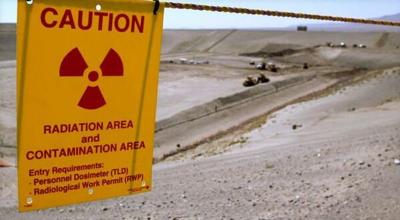
U.S. Energy Secretary Rick Perry says a hole that developed in the top of a nuclear waste storage tunnel in Washington state has been filled.
Perry announced Thursday morning that the 400-square foot (37 square meter) hole was filled swiftly and safely. He says the next step is to reduce risks at the aging tunnel.
The hole was discovered Tuesday morning on top of a nuclear waste storage tunnel on the Hanford Nuclear Reservation. Workers started filling the hole Wednesday.
The Energy Department has said no one was injured in the incident and no radiation was released to the environment.
Hanford, located in southcentral Washington state, has about 9,000 employees and most of them were told to stay home Wednesday.
The rail tunnel was built in 1956 out of timber, concrete and steel, and topped by eight feet of dirt. It was 360 feet long (109.73 meters).
Radioactive materials were brought into the tunnel by rail cars for about a decade. The tunnel was sealed in 1965, with eight rail cars loaded with nuclear waste stored inside.
The tunnel is a prime example of the sort of temporary methods to store radioactive waste that abound in the nation's nuclear weapons complex. The government has been working since the late 1980s to clean up Hanford, and the work is expected to last until 2060 and cost another $100 billion.
U.S. Sen. Ron Wyden, D-Ore., a frequent Hanford critic, said the cave-in shows that the temporary solutions the Energy Department has used for decades are starting to fail.
"The longer it takes to clean up Hanford, the higher the risk will be to workers, the public and the environment," Wyden said.
Hanford, built by the Manhattan Project in World War II, contains the nation's greatest volume of radioactive waste left over from the production of plutonium for nuclear weapons. The most dangerous are 56 million gallons of waste stored in 177 aging underground storage tanks, some of which have leaked.
The tunnel roof collapse caused soil on the surface above to sink 2 to 4 feet (half to 1.2 meters) over a 400 square foot (37 square meters) area, officials said.
The anti-nuclear group Beyond Nuclear said the incident helped show "radioactive waste management is out of control."
Democratic U.S. Sen. Maria Cantwell of Washington said worker safety must be the priority.
"My thoughts are with the first responders who are working to assess the situation on the ground," she said.
Worker safety has long been a concern at Hanford, which is located about 200 miles (322 kilometers) southeast of Seattle.
Washington Attorney General Bob Ferguson filed a lawsuit last fall against the Energy Department and its contractor, Washington River Protection Solutions, contending vapors released from underground nuclear waste tanks posed a serious risk to workers.
Ferguson said that since the early 1980s, hundreds of workers have been exposed to vapors escaping from the tanks and that those breathing the vapors developed nosebleeds, chest and lung pain, headaches, coughing, sore throats, irritated eyes and difficulty breathing.
Lawyers for the Energy Department have said no evidence has been provided showing workers have been harmed by vapors.
The collapse was discovered Tuesday as part of a routine inspection.
(Copyright 2017 The Associated Press. All rights reserved. This material may not be published, broadcast, rewritten or redistributed.)
